Nowadays, televisions and cinemas have a remarkable image quality and size, computer games boast impressive graphics, and portable media devices make it possible to watch movies anywhere you want.
But, before the birth of modern multimedia, our ancestors were all but cut off from vivid graphics and virtual reality. Innovative low-tech devices delivered amazing effects and fulfilled almost the same role that television, cinema and media players do today. Some features of these even modern multimedia does not match.
1. THE PANORAMA
Cinema and television create an illusion of movement by showing a sequence of still images of mostly 24 frames per second. Before cinema was invented, a similar effect was created with another, more cumbersome system.
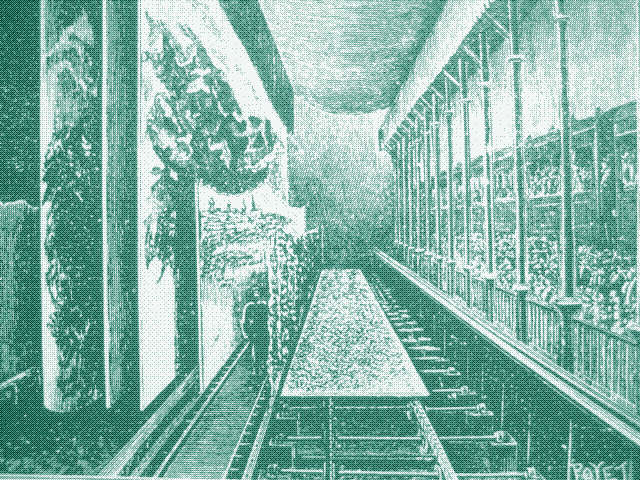
Artists made very wide paintings (sometimes up to several kilometres in length and as high as a present cinema screen) which were attached to two large mechanically driven cylinder-shaped spools. The screen was then slowly rolled up on one side, while being unwound on the other side.
Four screens
Travel was the favourite theme of these moving panoramas: spectators could be taken on a steamship voyage along the Nile, a rail journey from Moscow to Peking, an adventure to the Arctic regions or on a trip on a hot-air balloon (in this case the screen was rolled up vertically). Other popular themes included biblical or legendary stories and famous battles.
With time, moving panoramas became quite sophisticated. In one of the best documented examples – the “Trans-Siberian railroad” panorama shown in 1900 – three additional smaller screens were added in front of the main screen.
Nearest to the spectators stood a horizontal screen displaying the sand and pebble stones of the railroad track, moving at 300 meters per minute. Next a vertical screen displaying shrubs, moving at a speed of 120 meters per minutes.
Behind that was a larger screen exposing the cities and houses nearby the railway, moving at 40 meters per minute. The last and largest screen stood 8 meters high and moved slowly at only 5 meters a minute, presenting the sky, mountains, woods, clouds and villages and cities further away.
To complement the experience, spectators were seated in mock train carriages while they watched the panorama. The ‘trainride’, accompanied by sound-effects and a narrative explaining what was seen – lasted 45 minutes.
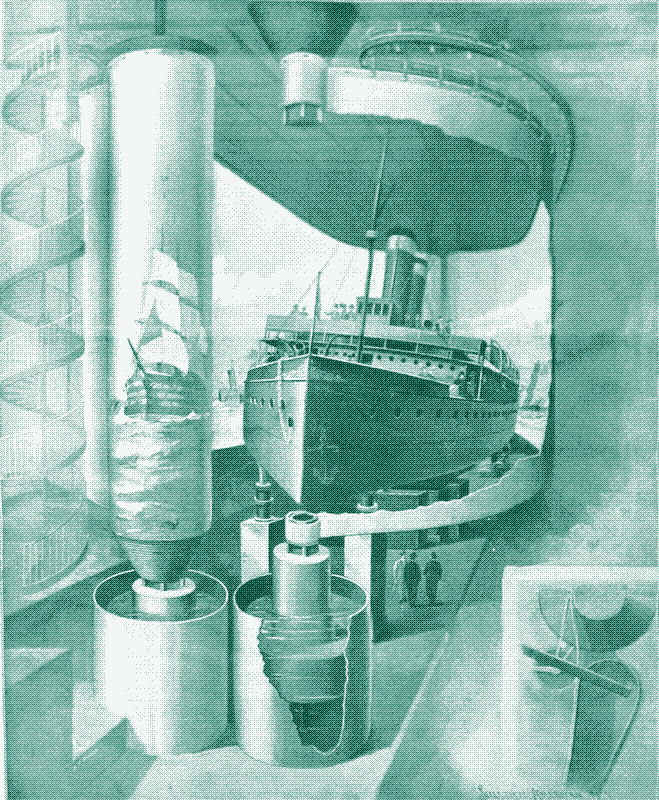
In another panorama simulating a boat ride, the passengers were also moved up and down in a replica of a steamboat to imitate the effects of the waves (this was also called a mareorama, see picture above). The experience was completed with steam whistles, smoke and wind effects.
A moving panorama (“The herioc life and career of Garibaldi”) was digitalized at high resolution and can be seen on the internet (part 1 & part 2 & the introduction to the project).
Circular panoramas
Panoramas have a deeper history than the present-day cinema. They experienced the height of their popularity in the 1850s and maintained being the preferred mass medium until the beginning of the 20th century.
Moving panoramas evolved out of circular panoramas, which were patented in 1787 in the UK by Robert Barker (see one of his smaller paintings here). They were exposed in specially designed, circular buildings (rotundas), with a typical diameter of 40 meters and a height of up to 20 meters.
Panorama paintings were nothing new then, but being completely surrounded by the scene gave spectators a different perspective, and a heightened sense of perceived reality. Some of these paintings are currently available on the internet, but when portrayed on a flat surface the effect of the circular panorama is pretty much lost.
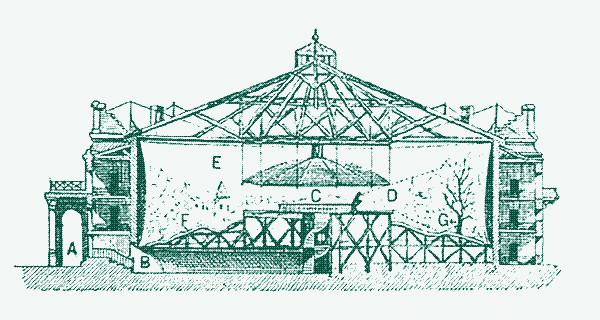
These circular panoramas were shown in a place for one season and then moved around the country and around the globe, meaning that they were seen by hundreds of thousands of people. The most popular showings were the depiction of famous (and mostly recent) battles. Other included themes were landscapes, cityscapes, biblical scenes or gardens (a panorama of Versailles was the first to be shown in the US, in 1829).
Panoramas were also used to attract immigrants to the New World. At the end of the 19th century, Paris had 13 rotundas. Almost every large city in Europe and in parts of the US had at least one panorama building. Today, only about a dozen of these buildings remain.
Team work
The panorama combined art and technological innovation to produce a popular spectacle. It was the cinema of its time, providing spectators with an outlet for escapism, a chance to travel to exotic lands and times. Panoramas demanded a large initial investment, which was reimbursed by entrance fees.
Just as on movie sets it took a large team of people to put a panorama together. Over approximately one year, the requirements for the making of a panorama were as follows: investigating the scene (by travel), making sketches, and of course the painting itself.
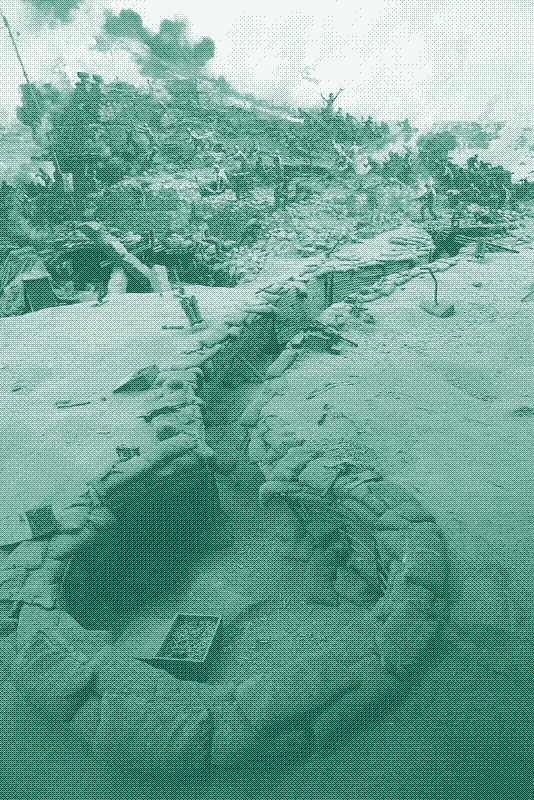
Painting a circular panorama was quite a challenge. The correct usage of perspective was imperative and the use of colours had to be perfect to maintain the illusion from every angle. Just as with moving panoramas, the illusion of circular panoramas was heightened by additional effects.
The spectators could not see the top or bottom of the painting. They were standing underneath a shelter, and on the floor between the public platform and the painting itself objects were placed – like trenches, weapons, helmets and cannons in the case of a battle.
These objects were partly painted and partly real, which further heightened the illusion of being a part of the place projected (which is shown very well in this - modern - egyptian panorama above). Light effects and a soundtrack completed the illusion. Before arriving at the scene, the spectators went through a darkened, disorienting corridor.
Souvenirs
Small reproductions of panoramas were sold as souvenirs, a gesture similar to the buying of a dvd after seeing the movie on a cinema screen. The panorama was – of course – made almost obsolete bythe introduction of cinema (through an intermediate step called cinerama), but in Russia and Asia particularly, they continued to be popular well into the 20th century.

Even today, some enthusiasts keep the art form alive (see for example this panorama of Big Sur below). Thanks to digital imaging technology and the internet, the panorama has found a new niche, that of virtual panoramic scenes. However, the effect is not quite the same as the viewer is not physically immersed in the space.
Cut to pieces
Because of their size, most panorama paintings were destroyed or cut into pieces which were then sold to collectors. The website www.panoramapainting.com gives an overview of all remaining panoramas worldwide, stored in musea or still on display, and directs you to the websites for more information. Some panoramas can be seen online.
2. THE STEREOSCOPE
In the 20th century, television became the preferred mass medium for entertainment, education and information. Before this, in the 19th century, that role was fulfilled by the stereoscope, a device that enabled two-dimensional images to be transformed into three-dimensional views.
For us, the stereoscope seems nothing more than the ancestor of the View Master, a children’s toy that is still being sold today. However, in the 1800s, the enormously popular stereoscope occupied a central role in every western household. A large diversity of the product was available: from handheld devices over table models to large saloon floor models for the whole family, resembling a television set.
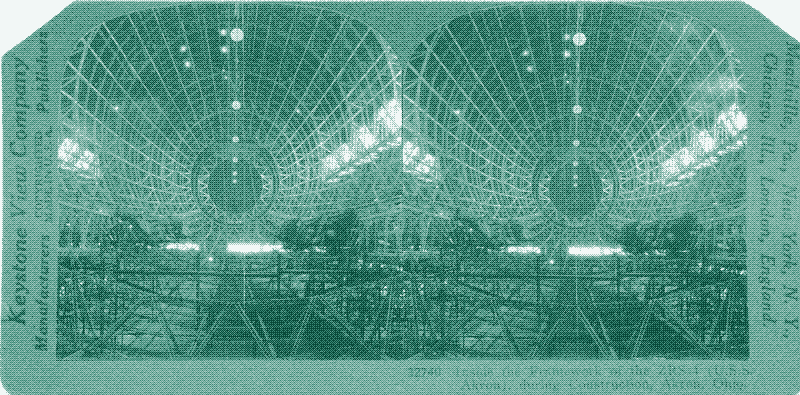
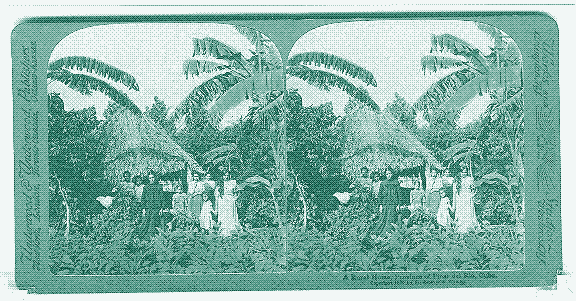
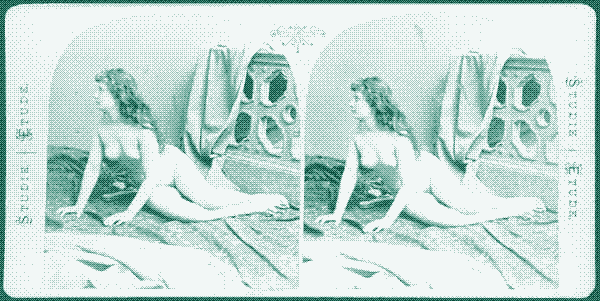
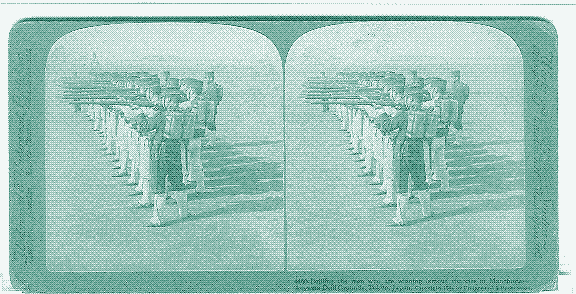
The stereoscope projects the illusion of depth by showing two pictures of the same scene or object next to each other, both taken from a slightly different angle (a horizontal difference of about 6 centimetres, the distance between two human eyes). Experienced observers can enjoy the stereoscopic effect without a viewer, with hard concentration and focus. Some stereoviews change their appearance in the presence of strong background light.
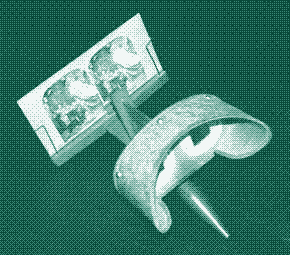
The device was thought of in the 1830s and arrived on the market in 1851. At first, stereoscopic views were drawn by hand, but it was with the incorporation of photographs that the technology really took off, because it made the production much easier and faster. Soon afterwards cameras with two lenses were introduced, so that the pictures could be taken with just one click.
Stereoview collections
Popular themes were landscapes, buildings, monuments, nudes (both male and female), war scenes, scientific subjects and exotic places. Two large stereoview collections can be found here (divided by theme) and here (divided by country). Links to all the databases of stereoviews on the internet are available here.
3. THE MAGIC LANTERN
The magic lantern is a most intriguing pre-cinema device. Similar to a present-day slide projector it enlarges projections from smaller transparant slides (painted or photographed).
In its simplest form, the fantascope fulfilled the same role as the stereoscope, sharing with people stories, things and places they had never seen or heard of before. For its time, the magic lantern achieved a level of technology that has yet to be matched by today’s standards.
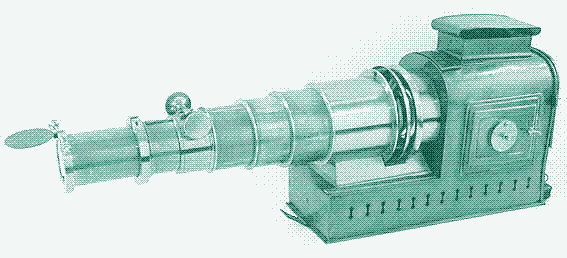
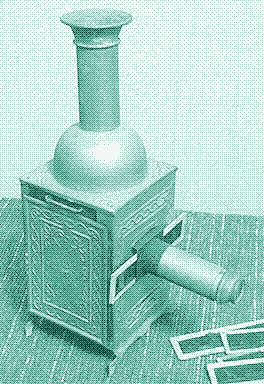
The magic lantern was invented in mid 17th century and has an odd appearance of which many variations exist. In essence, it comprises of a lightproof box except for a peephole on which a lens is mounted. The top of the box has a roof-like appearance with a tube resembling a chimney, through which the smoke and heat of the light source (candles or oil lamps - later on electric sources were used) can escape.
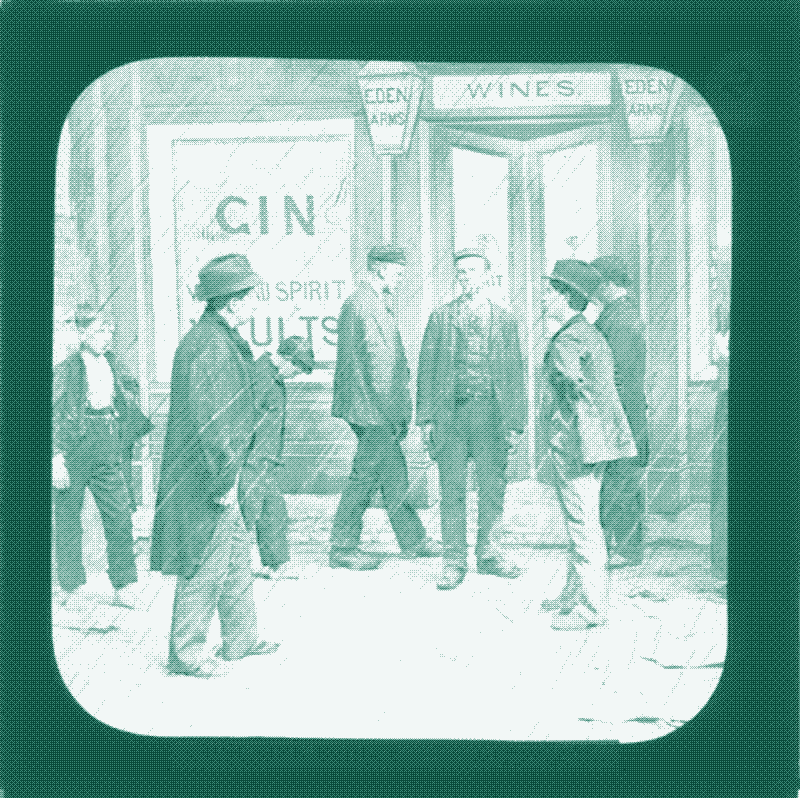
Inside the box there is a parabolic mirror to reflect the light. People owned magic laterns, but just as was the case with peepshows, showmen travelled from place to place to give performances.
Opaque objects
Other (later) types of magic lanterns did not project transparant slides but two-dimensional opaque images such as engravings, drawings, pages of books, pictures and even three-dimensional objects like puppets, skulls, coins or leaves. These devices are called episcopes and epidiascopes (the latter is the name for a magic lantern that can project both transparent slides as well as opaque objects). An intense light, placed inside the box, illuminates the object from both sides. The objects are hung upside down in the box and appear upright on the wall or the screen, in their original colour and texture.
Phantasmagoria
Eventually, the magic lantern did more than just project images on a wall. By sliding two images over each other, effects could be obtained, like a sleeping man swallowing rats. Parts of 3D puppets were made movable with steel wire tied together. To make the object move on the screen, the mechanism was being operated from outside the box.
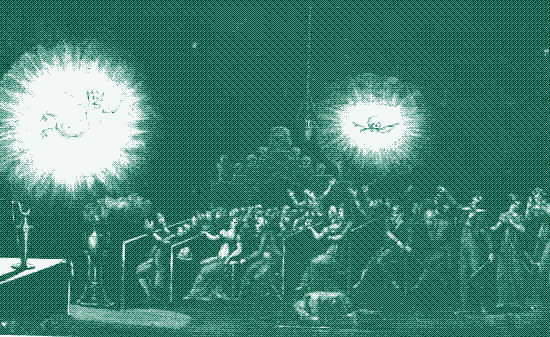
But the most remarkable use of the magic lantern appeared with the so-called Phantasmagoria shows. These were the late 18th century ancestor of the horror movie (more information here, here and here). For these shows, the magic lantern was mounted on wheels, which made it look like a film camera. The phantascope (or fantascope), as was called this type of magic lantern, had several capacities of a movie camera - one of which was auto-focus.
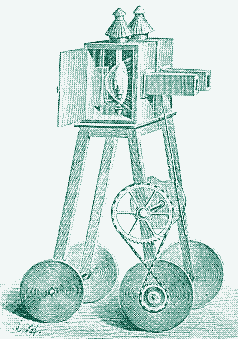
Often, skeletons, demons, ghosts and witches were projected on a translucent screen or a smoke screen between the phantascope and the spectators. By rolling the device forwards and backwards, the image on the wall became smaller or bigger, giving the spectators the illusion that the ghost was attacking them or moving away and vanishing.
The showmen sometimes used several projectors simultaneously, for projecting several moving ghosts. Later on, optical effects using mirrors were added, which made ghosts appear in all places. Combined with freightening sounds and smoke these effects this scared many people half to death.
Ombre Blanche
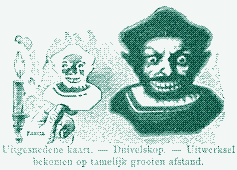
Another technique of the phantasmagoria was the “Ombre Blanche” or white shadow, the opposite of the better known shadow play. This could be considered the low-tech variant of the phantascope, since all that was needed was a peep box without a lens and a very faint light source like a birtday candle. Yet here, several ghosts in different colours could be moving through a darkened room, without complex actions or mechanical constructions.
4. THE PEEPSHOW
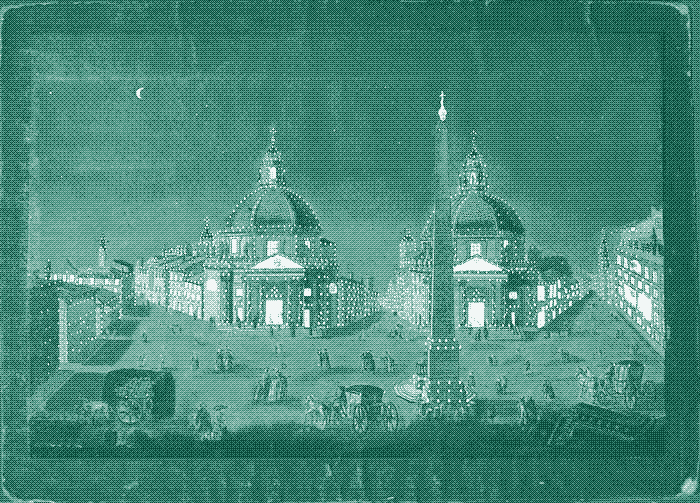
The peepshow could be described as the first modern multimedia gadget. It is a box with an eyehole, through which the spectator can see a miniature scene, painted or constructed in perspective (or a combination of both).
Both the stereoscope and the magic lantern evolved out of the peepshow, which was invented around 1660 and had an even earlier ancestor in the 13th century (the perspective views of Leon Battista Alberti).
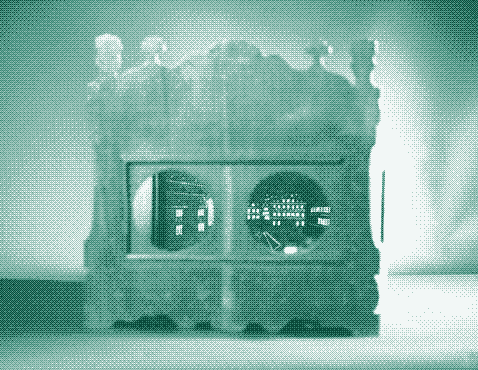
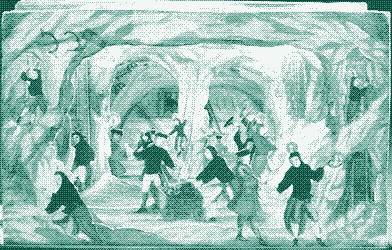
An exaggerated perspective, effective use of colour and light effects and (sometimes) a simple lens create the illusion of depth. Light is externally supplied by the sun or the moon, or from candles placed inside the wooden box. All this creates a very realistic effect, which would amaze even 21st century high-tech media addicts.
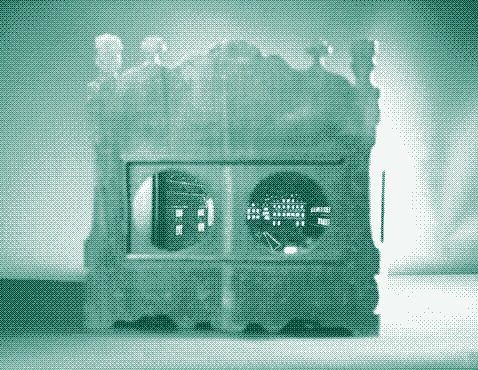
A peepshow sometimes had several eyeholes (like the early Dutch box above), enabling more people to watch the scene at the same time. It could be a small, portable device, or a larger table or floor model. The first televisions in the 20th century used peeping - the simple act of gazing through an eyehole.
Showmen
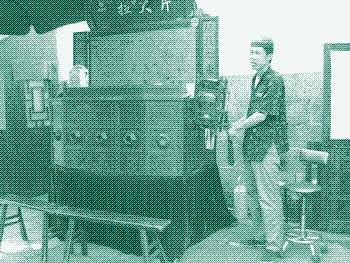
Peepshows were run by showmen travelling from village to village. Sometimes, they manipulated parts of the scene from the outside while the spectators were watching. In most countries today, the peepshow is mainly used in an erotic context. However, in some places the function of the original peepshow is still prevalent. The picture below shows a peepshow in China, with 5 eyeholes.
It will not be long before the Chinese follow suit and will also swap all their ancient multimedia for a flat screen television and a game-console. The problem lies in the world not being able to find an efficient energy source able to power all our high-tech 21st century gadgets, as unfortunately candles or moonlight just don’t cut it anymore.
Reactions
To make a comment, please send an e-mail to solar (at) lowtechmagazine (dot) com. Your e-mail address is not used for other purposes, and will be deleted after the comment is published. If you don’t want your real name to be published, sign the e-mail with the name you want to appear.
Reactions
dedus
i’ve actually been to a panorama before, the pleven panorama in bulgaria it depicts scenes of the russo-turkish war of 1877-78