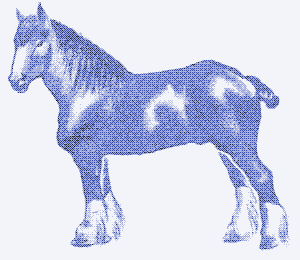
Horses and other draft and pack animals revolutionized transportation, war, hunting, manufacturing and agriculture. Work horses formed the backbone of industrial society until the first decennia of the 20th century, mining coal, ploughing fields and transporting goods and people in fast growing cities.
Reintroducing horses in city traffic would be a bad idea - cars might be noisy, dangerous and polluting, but mounts are even worse. In agriculture, however, animal power would bring surprisingly large environmental profits.
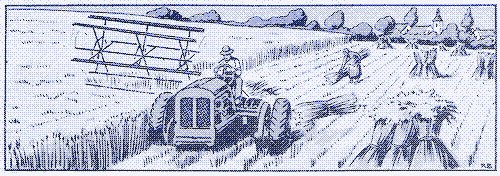
Replacing tractors with horses does not mean going back to the middle ages, nor does it exclude heavy machinery, high yields or high-tech
For several thousands of years, horses, donkeys, mules, oxen, camels, buffaloes, llamas and elephants were the only means of transportation, next to walking. Animals pulled carts and sledges loaded with goods or people, and trains of pack animals crossed hundreds of kilometres of mountain ranges, jungles and deserts.
The arrival of railways and steam machines in the 19th century raised the need for animal transport over short and medium distances substantially. Railways, steamships and factories generated a lot of extra freight traffic.
Work horses were responsible for the shunting of steam trains and for the hauling of coal to stations and factories. In the mines coal was transported by thousands of horses who never saw daylight. The rapidly growing human population in cities was transported by horse cabs, omnibuses and trams.
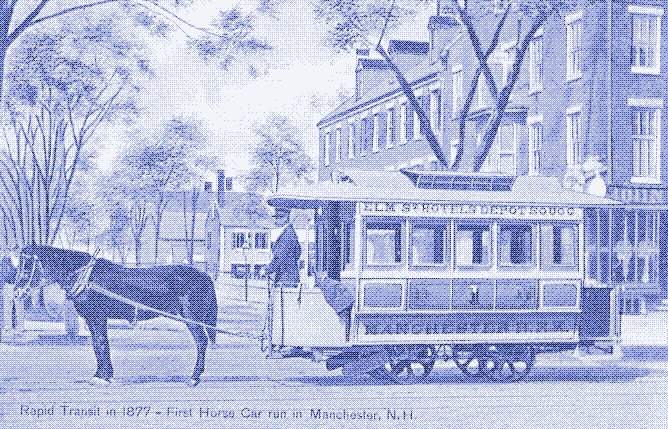
In 1890, there were an estimated 300,000 horses in London, which at that time had a human population of around 4.5 million (or 1 horse for every 15 people). In 1880, New York had between 150,000 and 175,000 horses, while the total amount of horses in American cities in 1900 was estimated at 3 to 5 million.
Not all of these horses were on the streets at the same time, since the animals worked in shifts. Still, at the end of the nineteenth century, the horse population in cities like London and New York became so large that health problems emerged.
Dung in the City
In 1880, the 12,500 horses in a small city like Milwaukee (then 350,000 people) produced 133 tonnes of manure each day – more than 10 kilograms per horse per day. That means that the horse population in London must have produced around 3,000 tonnes of dung per day, of which a substantial amount landed on the paving-stones. On dry days, the muck became dust that stuck to people’s faces and clothes. On rainy days, streets were transformed in open sewers.
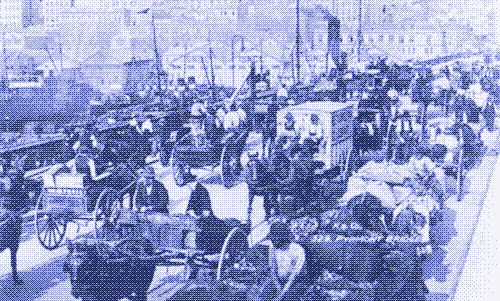
Apart from pollution, thousands of iron horseshoes and wheels must have made a terrible racket, and traffic accidents were no less frequent than they are today. Moreover, being a horse in the city at the end of the 19th century was not an enviable fate. Pulling carriages crammed with people or goods (sometimes with weights of over ten tons) on dirty and slippery cobble-stones was so exhausting that most animals dropped dead after just a few years of work.
Tractors don’t reproduce, and they don’t fertilize the soil
While using pack and draft animals for long distance travel might not be such a bad idea (at least it’s good to know that the end of oil does not necessarily mean the end of international trade), reintroducing horses or other animals in city traffic would be plain crazy. However, the principal reason why horse power is unsuited for city traffic - dung - turns out to be a very interesting quality when it comes to agriculture.
Horses in Agriculture
Replacing tractors with horses would be a good move since horse manure is a perfect fertilizer for agricultural soil. Since tractors don’t produce excrements, fertilizers have to come from somewhere else. That can be manure from animals which are being raised for their meat, or (mostly) artificial fertilizers. In both cases, it takes additional fossil fuels to fertilize the soil – for transporting animal manure to the fields, or for manufacturing fossil fuel based fertilizers (and transporting them too).
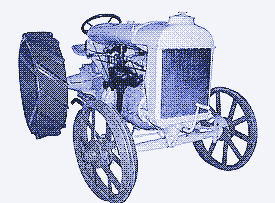
Horses have more advantages over tractors. They reproduce themselves, while tractors don’t. That means more oil saved, and other resources like water and metals, because if you switch to horses you don’t have to manufacture tractors. And while tractors need fossil fuels to operate, horses don’t. Large tractors have engines of up to 500 horsepower, which makes them consume up to twice as much fuel as a large SUV.
Switching (back) from tractors to horses would make agriculture almost completely independent of oil and minerals – and that could make quite a difference in a world that is (according to many) running out of fossil fuels and minerals. Horses could mean food security, without any need for importing anything. Moreover, horses don’t emit greenhouse gases worth mentioning (contrary to ruminants like cows) and they don’t pollute the air. Horses might be the solution that agriculture needs.
Fodder or Diesel
Of course, horses need energy too. No fossil energy, but food. This means that replacing tractors with horses would raise the need for additional agricultural land to grow feed for the animals (land that in turn has to be cultivated by extra horses).
Tractors could derive their fuel from agricultural land, too, if we turn food crops into bio-diesel or ethanol. Therefore, to know whether it is a useful strategy to replace tractors by horses, we have to know how many extra acres would be needed to feed the horses, and how many acres would be needed to “feed” the tractors.
“Powering agriculture with tractors requires almost 2.5 times as much (bio)energy than powering agriculture with horses”
This calculation was done in a study published in the ‘American Journal of Alternative Agriculture’, eight years ago. With oil prices almost 4 times lower than today, the researchers might as well have been talking to a brick wall.
Today, however, amidst alarming reports on peak oil and food shortages, their findings sound very appealing. Based on the amount of horses relative to crop area in Northern America in 1920 (when only 3.6 percent of farms had a tractor), as well as the amount of horses operated in 1997 on Amish farms, the researchers calculated that America would now need 23 million horses to cultivate the present 147 million hectares of farmland.
Tractor versus horse
Taking into account the annual feeds for work horses (1,300 kg of corn grain, 1,600 kg of alfalfa and 500 kg of harvested roughage) and the national yields for these crops during the past decade, they conclude that the 23 million horses would require 9 million hectare of agricultural land for food, or 6 percent of US cropland. To “feed” the tractors with crops, 7.4 million hectares of agricultural land is needed, or 5 percent of cropland, which makes tractors slightly more efficient than horses.
To make a fair comparison, however, it should also be taken into account that horses make their own fertilizer without any extra energy input and that they reproduce themselves, while tractors need artificial fertilizers and have to be manufactured (and replaced). The researchers express these energy needs in terms of cropland requirements, to be able to compare them with the other results (they take the view that the fertilizers and tractors are produced with energy delivered by energy crops). They also included the energy needed to turn crops into fodder.
The cropland needed to feed the horses then rises to 16 million hectare or 11 percent of US cropland (because of the energy needed to produce fodder from crops), while the cropland needed to “feed” and manufacture the tractors rises to 38 million hectares or 26 percent of American cropland. Conclusion: when everything is taken into account, powering agriculture with tractors requires almost 2.5 times more energy than powering agriculture with horses.
A Swedish study published in 2002 came to similar results: it concluded that a tractor-based agriculture consumes 67 percent more energy than a horse-based agriculture. The Swedish also calculated that the energy input in (local) agriculture increased 13-fold from 1927 to 1981, while total agricultural production in 1981 was only 2.4 times that in 1927. Find a link to the full pdf of the Swedish studies here.
High-tech Horses
Replacing tractors with horses is not without challenges, though. First of all, there are not enough horses or other draft animals around. Currently, there are some 9 million horses in the United States. If we want to reintroduce horses somewhere in the near future – say, when the oil runs out or becomes prohibitively expensive – we better start breeding.
Secondly, only a small share of those animals are work or draft horses, one ton muscular beasts with massive hindquarters, who are best suited for pulling weights. If normal riding horses would be used, many more animals are needed. Even if in theory any weight can be pulled by adding more and more light horses, in practice horse spans that are too large become unmanageable.
“Encouraging people to watch a horse’s ass instead of a computer screen might prove difficult”
Horses are not as low-tech and natural as they seem to be. Heavy work horses like the Percheron (picture left), the Belgian, the Shire or the Clydesdale are the result of centuries of cross-breeding by man. Unfortunately, these breeds are not doing so well.
The situation is not as alarming as it was fifty years ago, when many breeds of work horses were on the brink of extinction. Their numbers have risen again, but the population is still small enough to make them vulnerable to genetic deviations.
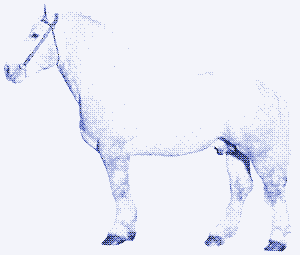
Furthermore, most of them are now bred for their looks only, and these characteristics do not always correspond with agricultural needs or even a good health. If draft horses become extinct, it would take many centuries to get them back on the scene (horse ’technology’ deteriorated before, after the decline of the ancient empires).
Human Power
Even if we can breed enough work horses, agriculture would have to change. The advantages of a tractor are speed and convenience. It is easier to steer a tractor than a span of horses, and it goes a lot faster. There is not so much difference in velocity, but because of their larger power, tractors can pull wider and heavier ploughs, so that they don’t have to go up and down the field as many times as a horse span. Using several horse spans at the same time makes up for that, but that also means that you need more farmers.
Horses also need to be taken care of, seven days a week, even when they are not working. And they might drop fertilizer on the field, but they are not evenly distributing it. All of this means that a horse-based agriculture would demand a lot more human power. More people would have to work in agriculture – while today, in industrialized countries, almost nobody works on the field anymore. Encouraging people to watch a horse’s ass instead of a computer screen might prove difficult.
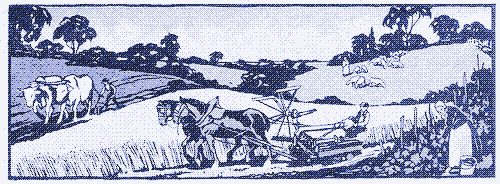
On the other hand, putting tractors in the stable does not mean going back to the middle ages, and it does not exclude heavy machinery, high yields or high-tech. Horses in agriculture are a fairly modern phenomenon. In antiquity and throughout the middle ages, fields were ploughed by oxen. In Europe and in North America horses took over in the 19th century with the introduction of a new generation of machinery that was too heavy for oxen. These machines required much more animal power, but they increased yields and decreased the need for man power substantially. Without tractors.
Lightweight Machinery
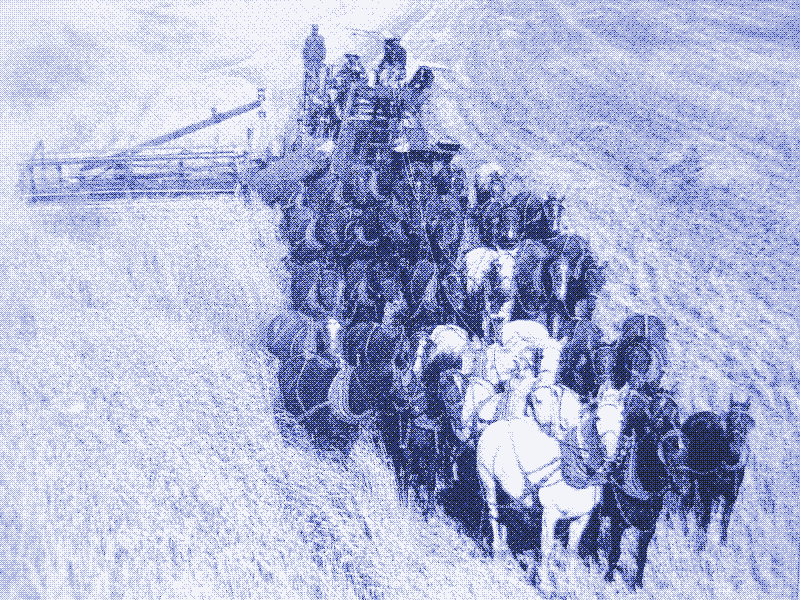
In the US in the second half of the 19th century, you could see 12-meter wide and 15-ton heavy harvesting machines pulled by spans of up to 40 horses, managed by just 5 or 6 farmers (see picture above). These were mostly riding horses, since most European draft horses were only imported at the end of the 19th century (these purebred animals were usually not working in the field, but only used to “upgrade” the existing horse population). Today, agricultural machinery is trimmed to powerful tractors. With 21st century technology, it must be possible to design extremely lightweight machinery that can combine horse power with high yields, high speeds and easy management.
Updates :
-
Find a link to the full pdf of the Swedish studies here.
-
Excellent article on the history of horsecars.
Reactions
To make a comment, please send an e-mail to solar (at) lowtechmagazine (dot) com. Your e-mail address is not used for other purposes, and will be deleted after the comment is published. If you don’t want your real name to be published, sign the e-mail with the name you want to appear.
Reactions
Ankesh Kothari
Interesting thought.
Its a different thinking pattern and I like that. But how practical is the idea of replacing tractors with horses?
How does it affect the prices of crops?
Because we’ll need more horses and more men than right now - crop prices will go up. Plus horse farming is not as efficient as tractor farming. It’ll take horses more time than tractors too.
So the farmer has no incentive to switch to horses…
Kris De Decker
Thanks a lot for the additional information! And sorry for the late publication of the latest reactions - my email box crashed
g583
Some of us who are concerned with the impact of various ecological & resource crises, are already studying & planning for the use of horses in agriculture and other applications.
Kris is correct that horse transport is the wrong option for cities. When horse transport was common, city streets in some places were typically 12 - 18" deep (1/3 to 1/2 metre) in muck consisting primarily of horse dung. Those high leather boots that people wore in those days were not a fashion statement but a necessity to keep the dung off their clothing. And it took an army of men with brooms to even begin to keep the streets clean (the interested reader is welcome to search under the name George Waring for papers on the first efforts in this direction).
In dry weather the dung turned to dust and got into the air and thence into the lungs; brucellosis was endemic as a result. Wet dung gave rise to major infestations of flies, which carried disease to any food they could reach.
In cities then, electric transport or internal combustion is still preferable.
However, in agriculture, and for rural transport where roads traffic is light, horses wil no doubt make a comeback. The equation is purely economic: in transport, it’s cost per unit weight per unit distance (e.g. cost per ton/mile, or possibly per 1,000 kg / km). In agriculture the cost equation is slightly more complex due to the increased labor requirement, but in any case there will come a point where those costs are less than the combined costs of fossil fuel based fertilizers and fossil fuel operated tractors, and at that point horses will come back into widespread use.
For an example of how horse tech will improve, look up the British Pagefield System of urban delivery (also used for refuse collection): horse-drawn vans, entirely modern in every way save for their motive power, were used for the local part of the trip; and the van boxes were winched onto a roll-off truck for long distance haulage to & from central depots. The point here being that the vans were up to date, with pneumatic tires and low working heights for the workers who loaded and unloaded the cargo. We can easily develop similar equipment today.
You raise a good point that horse breeding must begin soon to provide sufficient horses to meet the demand. This is going to become a very interesting issue as soon as horse power becomes economically desirable: those with the horses will earn a windfall.
I do have one criticism to raise. You say “Encouraging people to watch a horse’s ass instead of a computer screen might prove difficult.” I disagree: people already watch plenty of horses’ asses* on TV and listen to them on the radio. Converting to the real thing will be easy.
*Horse’s ass: American slang for a person who is stupid and obnoxious, or who is an unrepentant liar. For example, “Candidate so-and-so was just caught in another lie on the campaign trail; s/he is a real horse’s ass.”
S.P. Gass
Excellent article with several great points. I featured and excerpt and link to your story on my blog.
A farmer
Wow…this is quite possibly the worst idea I have ever heard. It is almost as bad as using corn for ethanol. This would never be cost effective. There is a reason we switched from horses to tractors…tractors get more done in a shorter period of time, allowing us to concentrate on other aspects of the farm.
t
What about elephants?
Tracy Ryan
What about the animal-rights perspective on this? Are humans necessarily entitled to enact this sort of wide-scale abuse of horses and other animals?
This blog is really interesting, but I’m disappointed to see the ethics angle missing from the idea of “horse power”.
Kansan
Interestingly enough the ICE power vehicles where seen as the solution to one pollution problem cities where dealing with, the exhaust emissions of the animals. For farmers to return to using draft animals on there operations there has to be an advantage for them to do so. Even horses need fuel that means an operation has to dedicate some of the time to growing, harvesting that fuel. There is always the possibility things will to degrade to the point society has no choice, in that event nothing will resemble to today or yesteryear. We may have moved beyond the point where old tech can serve the increased population.
Beth
I think it’s an awesome idea! It’d put an end to all the thousands of horses that are dying because no one cares for them.
Let us do it
Michi Phillips
I note that one of the reasons for the increase in unemployment in the US is the closing of family farms. Yes it will take man power to farm with horses again, but that is not necessarily a bad thing! First though we must change the image of the farmer from that of the uneducated hick to that of the eco-minded sexy-from-lots-of-physical-work neighbour.
Justin
Having grown up on a farm in North Dakota, USA, I can tell you that the situation would have to be truly drastic for this to ever happen. With tractors, two people can farm 1000 acres of grain crops (one additional person needed at harvest). My father (about 60 years old) now does nearly everything by himself while farming about 700 acres.
To do the same scale operation would take dozens of horses and at least a dozen people to manage them. I can tell you that the price of oil is less an issue than obtaining it. As long as diesel fuel can be bought and people are not willing to work for next to nothing, horses will see a resurgence only on tiny “hobby” farms. They will be used more as marketing than a truly useful part of the farm.
Justen
This is such a regressive idea it’s almost baffling as anything more than a theoretical exploration. Consider the cost in additional man-hours, not just in directing animal power but in breeding, feeding, handling and otherwise caring for the animal work force. Saying you get similar productivity but require more people is oxymoronic; productivity is a measure of work done per man-hour. Lost man-hours to agriculture means loss of productivity and specialization in other fields - if a larger percentage of the population is required in basic production, the society in question is able to support less skilled production. The poster below who mentioned this as a means of job creation needs to look up the broken window fallacy.
Surely refinements in manufacturing and energy production methods would far outweigh any efficiencies gained by regressing to animal-based power. I’m very interested in seeing some comparisons of emissions and pollutants by 500 horses as opposed to a single 500 horsepower engine, and the material costs of the associated equipment for small teams of horse-driven farming equipment as opposed to one or two large multi-purpose tractors. I am willing to bet the payoff is not going to be very impressive even compared to today’s technology. Alternative/clean energy tractors manufactured in local fab labs would almost certainly make the value proposition of animal power a complete joke, and they are closer than $400/barrel oil.
The Lyniezian
I would agree it is hardly either an efficient idea nor the best means of providing enough produce to feed modern populations. The upshot of it is of course more scope for employment. I would suggest the writer takes a closer look at permaculture, which actually bypasses traditional ideas of agriculture by letting the ecosystem provide the soil with its own nutrients (which normally get depleted and have to be added back in) and can provide higher yields than conventional agriculture for less effort. And hardly outside the spirit of this site- no high-tech solutions or modern intensive farming techniqus are necessary. A truly low-tech, if innovative rather than regressive, solution.
Whynot
I always find it interesting how we limit ourselves so tightly to what we think we know, even when trying to extend our imagination. Personally, I love the notion that horsepower could make a comeback.
Most of the replies I’ve just read which focus on the unlikeliness of horses coming back into use, are assuming every other factor would be the same as now, which of course is as ridiculous as they claim 21st century horse drawn agriculture would be. NOTHING is EVER the same. Our world is not static, it’s in constant change. And people are endlessly inventive.
I can definitely imagine reconfigurations of field sizes, crop varieties, working and ownership models, equipment weights and gearing, finance strategies, markets….all the factors supposed to be aligned to keep horse power as a conceit of the play farmers.
An interesting factoid not mentioned: the demise of the house sparrow in urban areas is often linked to the removal of horses, whose dung provided a rich supply of un- or partially digested hay seeds for the sparrows.
An additional value horses could provide is companionship and reconnection to the natural life cycles we too often ignore now. Sure many people can be caught yelling at a broken down car or tractor. But how often will the machine decide it has had enough and land a good kick?
Tim
Great article! However, this section seems a bit misleading:
“In Europe and in North America horses took over in the 19th century with the introduction of a new generation of machinery that was too heavy for oxen. These machines required much more animal power, but they increased yields and decreased the need for man power substantially.”
Oxen are actually stronger than horses and can pull greater loads. Horses are faster, more precise (can plow a straighter row and can turn around more sharply), and more versatile, but they have less pulling power and endurance.
Horses were then and are now more expensive to purchase and maintain. Farmers who switched to horses from oxen were paying a premium to spend less time out in the field staring at an animal’s ass.
Frank Kaiser
Why not combine high- and low tech?
Couldn’t we attach GPS steered vessels to horses thus avoiding the driver looking at the horse’s ass? (Compare this idea to robot jockeys in “http://en.wikipedia.org/wiki/Robot_jockey")
The future will for sure not look like the past.
It will be something new.
Frank Mancuso
100 years ago we had no oil and horses. 100 years from now we will have no oil or horses. We lived relatively decent lives 100 years ago and horses were a major part of mankind’s progress. Oil changed everything. We had it, used it, sold it and prospered from it to become a world superpower. We exported it and others also used it and found it. As our supplies diminish the wealth and power it created for us will ebb and flow to those with it. Our only hope for survival is to begin to think 100 years ago. What oil is left must be used wisely, we must consider becoming an agricultural nation again bartering food and clean water for our needs, because as other countries become more like us we need to survive as the earths resources are depleted. And yes someday horses may once again play a role in mankind’s survival. The BLM is removing our Wild Mustangs off their legal ranges in record numbers. The very rugged survivors that could virtually live on brush and little water may vanish forever. 500 years of survival of the fittest, natural selection and DNA that may one day be needed to mix with other breeds. We need to at least begin to think about such things before it’s too late.
David Veale
I’m farming with horses right now – and much prefer the view of their ass to that of my computer screen.
I don’t think anyone needs be worried about animal welfare with working horses. While it’s definitely possible to abuse them, they actually like to work, much the way a dog likes to go for a walk or chase a ball.
To the person who expressed concerns about emissions being comparable to those of tractors – this is complete nonsense. Tractors emit fossil carbon, and require fossil carbon to manufacture and maintain. Horses require none of that. They can gather their own feed, and any carbon emissions are from feed which recently extracted it from the atmosphere as it grew.
Peak oil is upon us. Industrialization is at serious risk, and risks our very future if it continues. The past holds most of the answers for our future, imho.
Bret
Horse or other draft animal power in an appropriate use works very well, is efficient, not at all cruel or exploitative, is “green” as you can get and often is far better for the land and workman than any tractor. But, the good Lord didn;t ever build a horse with hydraulics, a 3pt hitch or a PTO shaft sticking out it’s backside. So those of us that make use of animal power often find mixed power works best- use the tractor where the horse is clearly at a disadvantage and use the the horse where the tractor shows no advantage. It works.
One thing not mentioned is that any fool can care for and operate a tractor with little training. Animals require a lot more skill and some people just aren’t cut out for it.
For those more interested take a look at www.ruralheritage.com
Penny V
Interesting to find a link to an article in Swedish - which is conveniently my mother tongue. Thank you, I’ll give it a thorough read!
Gurbe
Farming with horses is a skill you can develop and enjoy. And use it’s advantages where best suited.
Like the horse in light tillage work on a produce farm. Less soil compaction.
Tractor and horses, use the best of both. Agriculture has a huge diversity in many aspects and it could be healthy to keep it divers.
There are lot’s of people working on modern horse equipment and related ideas:
http://www.modern-horse-power.org/
Natasha Combs
Animal rights issues aside (Most farmers/ranchers are VERY kind to their work animals which are in fact still being used, just not as plow beasts), they are LESS efficient than tractors. To pull the amount of work and power that you get from a tractor, you would have to increase your manpower. You would also have to increase the amount of feed. So your estimates on Hectares of food is WRONG. Horses need an estimated 5 acres per beast to survive food-wise. This is above and beyond the amount of cropland they’d be expected to work. Plus you have to have someone training them for the plows, people using the plows, people caring for them, and so forth. Not to mention vet bills, burial/disposal costs, tack/replacement tack needed for the plows. This is a very cost Prohibitive move. Paying that many extra expenses, not to mention people would drive the price of food so high that people would be driven to return to their own fields for a means of survival.
Seba
When Rudolf Diesel invented his engine, automobile barely existed and he had in mind that his engine will mostly be used to power farm machines, running on a part of the farmer’s crop turned into oil (as I know, peanut oil was used for the first tests of the Diesel engine). Hey, that sounds these “evil bio-fuel that may cause the world to starve”, as some short-sighted environmentalists use to say. But then, what is the difference between feeding a tractor or a combine, and feeding a work-horse that also “runs on bio-fuel” ? Well, whether the horse is working or not, you need to feed it, while you don’t feed a tractor that is not used. That (and the sanitary issues related to the horse dung which can be a disease vector) also explains why automobiles replaced horses. I am therefore skeptical about the efficiency of horses in agriculture. And perhaps it is possible to make slower tractors or to use electric trolley tractors, or…
However, I am not sure that the future of agriculture will rely on existing machines, whether they are powered by horses or engines. If permaculture proves to be the way to go for an oil-free agriculture and extends beyond amateur gardening (which is mostly the case now), then there is no more reason to plow (plowing oxidizes the inner part of the soil and kills its nutrients). Permaculture on a large scale may require some machines to produce food that is affordable, but they will be new machines that are adapted to the topography of permaculture fields (that are not flat). It is a technique that certainly requires animals (bees for pollination ; ducks, frogs or hedgehogs to eat the pests), but probably not horses.
Whatever, I have recently discovered this website and it is really great, I learned a lot. Congratulations for the work done !
Dorothy
It’s sad to read this article which enthusiastically and thoughtlessly consigns hundreds of thousands of animals to a life of heavy labor and a lifestyle counter to their instincts, for our benefit. There is no way this can be done without the animals suffering. Further the writer doesn’t seem to be familiar with anything but the pulling use of tractors, and they do much more than that. The multiplication of human labor to support this idea would, paradoxically, be a benefit – the most recent problem is increasing mechanization and automation of labor, leaving more and more people unemployed – but overall it just doesn’t add up.
However, if you consider lots of little agricultural robots, like roombas …
Garrett
I make a living farming, and I grew up on horseback, but I can assure you that this is a most unpractical idea.
Farmers were, are, and will continue to be practical types. They gave up using draft animals for a reason, and that reason is efficiency. My grandfather farmed with horses and loved horses, but remembered the day they traded in the team for their first tractor for what it was - a step forward.
My family dryland crops areas on the ragged edge of being too dry to farm. We are successful at it because we pinch pennies and take care of our ground. Our biggest issue is wind erosion, so we stay out of the fields as much as possible to protect against it. High horsepower tractors mean we can pull wider implements and make less passes, leaving standing residue to protect against drying winds. A 32 horse team pulling a combine makes that impossible.
Also, this article fails to account for the dirty, harsh drudgery that would result if you tried to substitute animal power for other power forms on the farm. Horses didn’t just pull implements, they provided power to a wide variety of stationary equipment that today is gas or electrically powered. There is romance in driving a team at the plow. There is no romance in dozens of animals chained to the yoke, endlessly walking in circles to produce the same paltry shaft power as a small gas engine.
Horses need to be fed every day. Equipment only needs to be fed when you use it. If we don’t like feeding equipment fossil fuel then we need to come up with something better, but horses ain’t it.
Bert
Arithmetic error: in the above calculations it should be 30 liters of diesel having to cost the same as 498 man-days, not 60 liters.
Myrtonos
Another big difference between a horse and a tractor is that the former has a mind of its own. A tractor has to be physically be driven by a human, turing the steering wheel and accelarating and breaking by physically moving two pedals. But a well trained well treated horse can (often) be directed using behaviour rather than force. Note that horses bulk at even small distractions, such as chains that jiggle, reflections on puddles, metal chanking and banging, chothing hanging on fences, and bight daylight (they have a natural tendency to move out of the shade, but not twoards bright sunlight).
So try to keep the field devoid of distractions that make them bulk.
Electric bicycle style power assistance (now used on The Docker) would improve the speed and convenince and reduce fatigue.
anon
Id like to find out if men could replace horses. A group of people would be much harder on the soil however.
Lee D.
Actually, according to several studies in Small Farmer’s Journal, farming with horses reduces costs and increases profits on farms under 300 acres or so in size. The value of the manure as fertilizer, and the sale of offspring were all included against the purchase price maintenance, and repair costs of a tractor use for an equivalent size farm.
Granite, there are some selfish people that I would not like to see driving horses. I do think that a culture of respect for the animals welfare can become dominant. I’m saying this as an experienced horseman that also has some experience working on organic farms.
It is actually happening already on more farms that some Tractor fans would suspect, and not only on Amish or Menonite farms. There has a been a renewed interest in using draft animals for farming. Last, in a world of constrained resources, tractors will become even more expensive. There will be a tipping point based on cost and not just on the religion of progress and dedication to the bigger is better philosophy.
http://smallfarmersjournal.com/
http://www.ruralheritage.com/
Cererean
I’m sure I read about a system which used ropes on pulleys to pull the farming equipment along, somewhere. Wouldn’t that make more sense? The system would be agnostic with regards to whatever is powering it - it doesn’t care whether the stationary generator uses diesel, hydropower, or even a team of horses (you’ll probably want a flywheel to smooth out the power). It perhaps would allow the manpower savings to be retained, whilst moving to a different power source, and if horses (why not oxen?) are used their manure would be easier to collect and spread over the field.
Suzy cyr
I have just let my horse eat weeds and grass that is free.
How do you think people traveled over the desert without a ton of hay and grain in the wagon?
Smaller farms with 80 acres and a mule
and use Hemp oil too.
Edward Hogan
I think we have a lesson from the Chinese in days gone by. Many may not realise that one of the great Chinese contributions to agricultural development was the the development of a proper harness enable the pulling strength of the animal to be properly utilized. it is now known that the Chinese developed this many centuries before Europe, It came as surprise therefore when early Western visitors found the plough horse not in widespread use in Northern China. The reason? A sobering one. Chinese farmers had discovered that with increasing pressure on farmland and consequent sub-division they could not afford to set aside enough farmland to grow the grain that a hardworking plough-horse needed . They had largely reverted to human muscle-power! Apparently it was a common sight to see several Chinese small cultivators attached to a plough and ploughing a field themselves!
Jonathan Wright
Our population today is a direct byproduct of the immense amount of energy liberated from oil during the machine age, especially the post-WWII period. A great deal of which was turned into food, resulting in vast surpluses which in turn meant vast numbers of new human beings coming on the scene - the famous “hockey-stick graph”. A return to horses - which would be brilliant by the way - would not support such numbers, just a fraction-of in fact. This is actually a very good thing where the biosphere is concerned as well as for those human beings who survive the great dieoff resulting. Not so great for the billions who starve. But that’s coming anyway, the dieoff, the billions starving. Our “carbon spike” world is a one-off situation that will not be maintained much longer, with or without oil. Oil being a non-renewable. The impossibly favorable economics surrounding the resource through our zenith are no more. We are approaching the point where we will not be able to afford to burn what we produce. Then you better have a horse or you will be scratching in the dirt with a stick.
Emily Walton
Hello there,
I noticed that your article references an outdated stat. You mentioned that there are “9 million” horses in the United States. Based on our most recent data, these figures have been updated, and According to the latest research and data, There Are Almost 10.31 Million Horses in the US.
As one of the leading organizations in advocacy, It’s the World Animal Foundation’s utmost duty to ensure such statistics are current, not just on our platform but also on other relevant platforms.
Having recently revised our article with the newest statistics, I wanted to share this so you might consider a similar update or if you are considering to write on this topic in the near future.
For your reference and to verify the new statistics, please visit our page: https://worldanimalfoundation.org/advocate/how-many-horses-are-there/
To provide your audience with direct access to the latest data, we’d be grateful if you could link to our article when making the update.
Thank you for your attention to this.
Best Regards.
Emily Walton Asst. Outreach Manager WorldAnimalFoundation.org