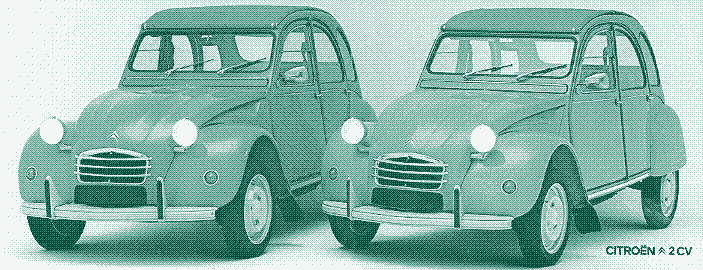
If you sometimes wonder why more energy efficient technology does not bring about more energy efficient cars, you should take a look at this collection of Citroën brochures (most of them in foreign languages) from the fifties, the sixties, the seventies and the eighties (more here, here, here and here).
These are all original, scanned leaflets of the legendary French hippie car “2CV” or “Deux Chevaux” (known as the “duck” or the “goat” in several European countries). In spite of all the high-tech that has been squeezed into cars since then, the 2CV from 1949 is still more energy efficient than the smallest model of the French car designer today. Why?
“If we really want more energy efficient cars, the 2CV shows us that we need not more, but less technology”
The 2CV was produced from 1949 until 1990 and sold almost exclusively in Europe. At the time of its introduction the car had an engine capacity of 375cc, a maximum power output of 8 horsepower (DIN-HP) and a top speed of 65 kilometres an hour (40 mph).
In 1954 the power was tuned up to 10 HP, which brought the top speed at 80 kilometres an hour (50 mph). In 1974 the power output rose to 24 HP, with a top speed of 102 kilometres an hour (63 mph). Later models had an engine capacity of 602cc, a maximum power output of 30 HP and a top speed of 120 kilometres an hour (75 mph).
500 kilograms
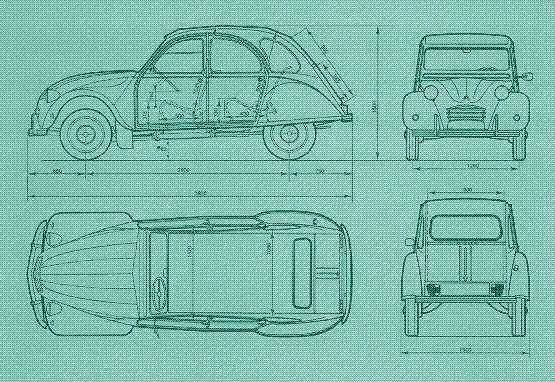
In spite of the much higher performance (an almost doubling of engine capacity, 4 times as much power output and a top speed almost twice as high) the weight of the hippie car remained the same at about 500 kilograms (sources: 1,2,3)
Today, there is not one car which comes even close to these figures. The smallest model of Citroën now on the market, the C1, weighs 810 kilograms (despite the use of lighter materials). The Citroën C1 has an engine capacity of 998cc and a maximum power output of 68 HP, and it does 157 kilometres an hour (98 mph).
8 x more power
Compared to the first 2CV models, the weight of the smallest Citroën today has almost doubled, while the top speed more than doubled and the maximum power output rose by a factor of eight.
Surprisingly, the fuel consumption remained more or less the same. The C1 consumes 4.6 litres per 100 kilometres (61 miles per gallon), the 2CV consumed on average 4.4 litres (64 miles per gallon).
It is obvious that the engine of the C1 is many times more energy efficient than the engine of the 2CV, since the latter needed the same amount of fuel to power a much lighter and much slower vehicle.
In other words: if we would apply this modern technology in a car that is as light and slow as a 2CV from the fifties, we would now drive cars that scarcely burn any gasoline. Unfortunately, all technological progress was devoured by more weight, more power, more speed, more comfort and more electronics.
Safety belts
Part of the extra weight is the consequence of safety measures. Car manufacturers always hammer at this and of course more safety is a good thing. But, because at the same time the speed of the vehicles has raised substantially, and higher speeds mean more serious accidents, part of this progress is negated - just like the higher energy efficiency is negated by the higher performance. Moreover, safety belts are still the most important reason why traffic deaths plummeted since the seventies, and the weight of that mechanism is limited.
Comfort
Another reason for the higher weight and energy consumption is the advancement of comfort and electronics. The first 2CVs hardly had a dashboard that was worthy of the name. The vehicles had no heating or air-conditioning - there was not even a fuel gauge.
If you wanted to know how much gasoline you had left, you had to stop and poke a dipstick into the fuel tank.
If you wanted to know how much gasoline you had left, you had to stop and poke a dipstick into the fuel tank. Until the sixties, the windscreen wipers were driven by the wheels - and therefore did not work when the car was not moving (unless you powered them by hand).
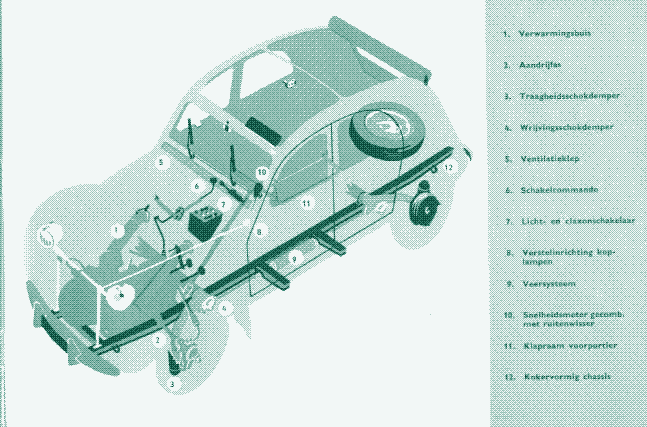
The windows of the 2CV could not even be opened mechanically, let alone by electricity: they were pushed open with your elbow. In today’s cars all these applications (and dozens of new applications) are run by their own electric motor.
These electronics push up energy consumption because they raise the weight of the car and because they consume energy themselves (electricity which is delivered by the combustion engine). If we really want more energy efficient cars, the 2CV shows us that we need not more, but less technology.
Brochures found via Things Magazine & Tecnología Obsoleta
Links:
These sites have more information on the Citroën 2CV (in English). Image: The Citroën 2CV. Also check out the brochures of the Panhard, the Hoffmann 2CV, the Dyane, the AMI, the plastic Mehari and other Citroën models.
Reactions
To make a comment, please send an e-mail to solar (at) lowtechmagazine (dot) com. Your e-mail address is not used for other purposes, and will be deleted after the comment is published. If you don’t want your real name to be published, sign the e-mail with the name you want to appear.
Reactions
Fschwep
Hum… The 2CV was, in fact, designed by a chief engineer from Michelin, during an epoch when Michelin owned Citroën. And it was designed in Clermont-Ferrand, in the French Auvergne region, where people have always been sticklers for efficiency. The 2CV was explicitly designed for poor farmers who had to use it to transport their produce to the market (without the rear seats it would take a grown pig) and drive it on the bad roads and tracks of this mountainous region. One of the anecdotal design constraints was the height: one had to be able to sit in it while wearing a hat - and the chief engineer in question was himself rather a tall man who wore a high hat, so the 2CV has a lot of headroom as a result… ;-)
Grumpy
One major reason why modern cars are heavier has been overlooked: crash protection.
Hit a non-deformable object at 30mph in a 2CV, and you will be seriously injured.
http://crash.citroenz.biz/2CV/
Hit one at the same speed in a C1, and you will walk away relatively unharmed.
http://crash.citroenz.biz/C1/
Cars with better crash protection are even heavier.
S.P. Gass
Grumpy, that’s a good point. I think the question becomes, would people be willing to give up crash protection for better gas mileage?
After all, the most important safety feature is the driver.
Kris De Decker
Sorry to send you away, but there is someone making an interesting comment on this somewhere else:
“To the gentleman who posits ‘Impact safety means weight’: incorrect. Impact safety is the result of good design. Good design adds no weight to the vehicle. Formula 1 race cars weigh as little as 440KG, and drivers often walk away from crashes at triple-digit speeds.”
Read the full comment (physics included) here:
http://www.stumbleupon.com/url/www.lowtechmagazine.com/2008/06/the-citroen-2cv-cleantech-from-the-1940s.html
Adrian K
Just as a by the by, the 2CV engine needs leaded Petrol,new cars don’t. It’s also air cooled, no water cooling. Just my penny’s worth.
MBM
One factor not mentioned here is the incredibly low emissions levels of modern engines compared to 40s powerplants. Although fuel usage is minimized by computer controlled engine management systems my guess is that efficiency would be higher yet if engines were designed purely for fuel economy.
Michael
On the subject of efficiency and low emissions,I recently came across an interesting concept for a sort of modern steam engine,the Cyclone engine.Like other steam engines,torque is maximum at 0 RPM,therefore no transmission is needed,it doesn’t need oil changes,it runs on any liquid fuel,and it’s overall efficiency is in the diesel range.The emissions are kept ultra low because it is an external combustion engine,tuned for complete combustion.Other versions of the engine can run on waste industrial heat,solar,etc.
See: http://tinyurl.com/8tkmtk
Gene (Yvon Le Breton)
Sorry but the leaded Petrol comment is not correct.
All aluminium head Citroens including the 2CV had and have steel valve seats. Lead in Petrol did many things, polution, upped octane, and cushioning to prevent (valve recession)but only in cast iron heads where the seats were ground in directly. While the octane of the fuel has to be in line with the compression ratio (3 different one in the 602 engines) leaded Petro and lead additivies are not necessary.
eddy
No, no, no… this is all wrong. If we are to go down this route, let us not do it by halves: a bicycle is orders of magnitude more efficient and less polluting than a 2CV - probably more comfortable, and certainly better for health! Additionally, its top speed on a flat with no wind approaches 35mph - faster still (and even more efficient) if it is ridden skilfully in a peloton or a paceline!
The only possible advantage of driving a 2CV is if you are old and infirm or you need to a carry a pig. Most things that are carried in an average 2CV journey can be carried on a bicycle (either in panniers or a trailer) with no problem. To my mind, a car is for luxurious travel, shifting extremely bulky/heavy loads, or travelling very fast - since the 2CV cannot do any of these, prefer the bicycle (albeit, the hi-tech carbon-fibre bicycle!)
Ron
2cv from 1970 onwards run on unleaded fuel, it can run on e85, this will cost you 25 euro for the conversion. The only problem is that the air cooled engine has a 9% co2 level.
Alex
Grumpy makes a comment on impact protection, but the two pages he posts aren’t comparing like with like.
The 2CV was crash tested in the 60’s and 70’s by being fired into a solid wall at 40-45 kph, the Citroen C1 is fired into a deformable barrier such than only the the front quarter of the car strikes at 64 kph.
So sadly it’s nigh on impossible to compare.
As the former owner of a 2Cv who walked away from crashing one into the side of a Rover Metro at 50 mph, I can say they’re surprisingly good. The bonnet’s long, there’s plenty of room between the engine and the driver’s feet and of course there’s no dashboard to crush your knees.
But less weight is the way to go, and roll on Gordon Murray’s new vehicle as he’s of the same mind and of course is a hugely capable car designer (think Maclaren F1).
Lupodriver
It is possible to have the best of both worlds - modern safety and low fuel consumption of a lighter car.
I drive a VW Lupo 1.2 TDI 3L which is rated 4/5 stars by EuroNCAP for collision safety.
Although it rarely (ie. never) reaches the 3 l/100km (from which the “3L” comes) it NEVER uses more than 3.7 l/100km (61.9 MPG) - and that’s not a theoretical number, but the one from the onboard computer.
The car seats four adults (the two front ones comfortably) and has sufficient headroom for tall people - although it doesn’t exactly have a lot of boot space.
Sometimes the solution isn’t winding back the technological clock, but using current technologies (turbo, electronic engine control etc.) with lighter materials (aluminium, titanium) - and keeping cars small when at all possible.
kdd
I agree. It is not my wish to turn back the technological clock, but I think that many obsolete technologies can be an inspiration when designing new technology. The best of both worlds, as you describe it.
One thing to keep in mind though, is the embedded energy of many new, high-tech materials. Aluminum and Titanium, for instance, require much more energy to produce than steel. They are also lighter than steel, which can lead to a better fuel economy, so I am not saying they are by definition a bad choice. But it should be taken into account when you want to find out which car is the least damaging to the environment.
Colin Hawes
I think your fuel consumption figures for the 2CV are a little optimistic. I drove two 2CV6s over 14 years.I never achieved 60 mpg.
On urban driving, I managed low to mid forties. If I “thrashed” them at maximum speed on the motorway it could be a poor as high thirties. If I took it easy on the motorway it would be mid to high forties. The best I ever achieved was 58 mpg. That was in 1991 between Kinlochbervie and Kingussie in Scotland. Mainly on fairly empty roads where I was taking my time and admiring the scenery.
It would be good to see a modern equivalent of the 2CV. But don’t imagine the 2CV was ever low tech. Despite it’s funny shape, it was pretty advanced for it’s day.
2cvman
one thing you all forget..Aerodynamics! The 2CV has a dragcoefficient of 0.6. Twice as high as the more modern car.
Furlongs per pint
Further to comment #3: the fuel efficiency conversions in the article are based upon the gallons being Imperial. For US gallons, the conversions become 4.6 l/100 km = 51.1 mi/gal and 4.4 l/100 km = 53.4 mi/gal.
Easy formulas for the conversions between l/100 km and mi/gal are:
to/from Imperial: 282.48 ÷ x = y
to/from US: 235.21 ÷ x = y
If x is l/100 km, then y becomes mi/gal; if x is mi/gal, then y becomes l/100 km.
Marios
I have read so many interesting opinions. The 2cv is a great car. I have been driving one for 16 years and I think it was ahead of its time. It has a great suspension, it’s fun to drive and I love the way it looks, not to mention its practicality and the opening top. However, I think that a bit more technology would make it more fuel efficient, a bit more powerful (not to show off, but to overtake with safety) and I would like a quicker steering wheel. In any case, I really love this car and I think that in many ways it could show the way forward.
RussellG
My 2CVs have always averaged well over 40mpg - usually 44-49, depending on use. I once managed 58mpg on a long trip at a steady 55-60mph.
One of the most practical aspects is their ease of servicing, the front wings can be removed in 10 minutes to make everything easily accessible. Mechanical repairs are unusual because of the cars’ over-engineering, although the steering swivel pins are the exception, if not greased regularly. Quick and easy to change, however, if not already bodged by a lazy/incompetent sort.
The very cleverness and minimalism of the design does not lend itself to rebuilds with inferior quality parts - some popular replacement chassis are desperately flimsy, new engines are made from poorer materials and I’ve driven quite a few ‘restored’ cars which have been utter dogs to drive. When you’ve only 29hp under your right foot, everything from the steering, handling and ride - not to mention a power-sapping gearbox or poor engine - is crucial to maintaining good progress.
There were never two cars the same which came off the production lines and material quality dropped off alarmingly from the mid 1980s. Combined with decades of use and abuse, some cars are divine to drive while others encourage many invectives.
Juan Marcos
What about my beloved Citroen AX ? Citroen’s second best seller after the 2CV. 640 Kg. From Wikipedia: “in 1989 a naturally aspirated diesel AX, using the 1360 cc all aluminium alloy TUD engine, managed a figure of 2.7 litres per 100 kilometres (100 mpg-imp; 87 mpg-US), totalling over 1,000 miles (1,609 km) from Dover to Barcelona.” Mine did not have air conditioning, electric windows … not even a radio. Unfortunately, no airbags and no ESP.
David
I once owned Citroen Dyane 4 which was basically a 2CV with a more modern body. It had a 435cc engine. This was in the late 1970s in the UK.
While it was a great car to drive. It certainly had character and one learnt the technique of trying never to slow down because acceleration was terrible.
It was also a terrible vehicle to maintain. It required real weird tech to get to the brakes.
However, as far a fuel economy went it was nothing fantastic. The engine had to work flat out most of the time. It managed around 40 mpg (UK gallons)
I reckon the power was around 10 to 15kW at best.
I now have a Toyota Yaris with 1 litre motor and around 45 kW or power. It has average around 50 mpg. I say has because having done around 160 000 mile according to the on board calculator the average is now nearer 48 mpg.
Stuart
I never owned a 2CV but did ride in an AK400 and was even allowed to drive it. What can I say… I have loved the 2CV ever since and always planned to buy one, but Citroen pulled the plug before I could. By any technical standard, at the end it didn’t measure up to more modern cars, but its appearance, its character, they still bring tears to my eyes. Now I have a 1996 Toyota Tercel that I baby and it treats me well, but it just isn’t a 2CV…
Richard
We have a Suzuki Wagon R (Google kei car), a similar concept. Very ugly, but masses of room inside and very high headroom, 660 cc three-cylinder engine, and it does 100km on 4.53 litres, which is 62 miles per Imperial gallon. Not silent inside because weight is pared down everywhere, so there’s little sound insulation.
Doug
I was going to nit pick, but I’ll just simply while it’s fun to look at the cars of yesteryear, no progress can me made by attributing to them more to those cars than that’s valid to do so. The 2CV what was many needed at that time. Today we need our own Model T, VW Beetle,Citroen 2CV that fills our needs now, not something that filled the needs of of those 70 years ago who where in much more dire straights than we are in now. I’ll mention something that I hadn’t seen mentioned. That the basic components of today’s vehicle are much more durable.
Bill Young
I have found it!
The spiritual successor to the 2cv is a Dacia Dokker. I have been looking for a load-carrying, five seater car with a low purchase price, Euro 5 fuel consumption and high ground clearance. And I have been following this web page almost from the begining.
Riding a tram through Basel in Switzerland this week, I saw it advertised. Problem for me is, they don’t sell it in the UK which is where I need it.
Terry Regennitter
I was stationed in France in the 60’s and drove a Renault Friget.
I enjoyed riding in the 2CV ’s. I drove a 3 cylinder Metro 5 speed for many years and got 52 MPG. I pulled behind my motorhome.
I wanted to bring a 2CV back from France, but could not because of mechanical brakes.
happydead
I’m a french 22 yo citroen ami8 owner (ami8 is just a 2cv with a more aerodynamique body).
602cc 30hp 5,5l/100km to drive in under 110kmh.
cheap, fun, so easy to understand and repair.
i don’t want to own an other vehicule.
i just think that we’ve to change our vision of the transport.
the question is not if the 2cv’s engine is efficient or not.
the question is : “why not to build cars with the same specifications but why modern technology ?”
we don’t need the power of the recent cars.
we don’t need more than 100km/h.
we don’t need this comfort.
we don’t need all the gadgets you can find today in a car.
we need to ask us what we realy need.
just look at the recubents (i’ve got one) or velomobiles, that’s the future !
Jim LaFortune
We are the happy/proud owners of a 1966 2CV which has been in the family for 28 years. We imported the car from Belgium into Baltimore after having Michelle Fornet overhaul it. (Beautiful job)and drove it home to Illinois without a single problem. It’s kept out of the nasty winter weather to insure preservation against salted roads, but in the summer we don’t hesitate to setout for a weekends travel. A Ferrari can be parked next to it, but the admirers will be around the “Duck”.
Omari
@ Krison on Formula 1 cars,they’re so safe because the cars are mostly carbon fiber. If someone develops a new way to manufacture carbon fiber as cheaply as say, steel, then we can start to say this safety and light weight combination will be accessible to the common person.
I’d say most importantly for the future is to invest more resources in battery technology for EV’s, lithiom ion isn’t cutting it with its weight and low energy capacity relative to what’s needed for modern cars. We’ve already got the tech for sustainable electricity generation, it just needs to be subsidized more. All very doable stuff but since it’s capitalism, you’ve just got to make the option better for the environment cheaper than the nasty one that’s better for the pockets.
jørgen g. rasmussen
I’ve owned several 2cvs; they all always started - even if the engine was packed with snow; if you drive them with imagination (i.e. - can imagine what or who pops up next, always remembering that you sit in a can) you’d be relatively safe; however, the soft shell by which you’re relatively well protected from the worst wind, rain and snow, will not prevent your fellow motorists’ occasional close meetings: my 3 last 2cvs were wrecked from the back, the side and the front by 3 (I hate to write it!:) women drivers; I was nor in the least hurt. Nowadays I have a Berlingo (I’m 77 and sometimes wonder why I’m sitting in a 4-wheel drawing-room) missing my old 2cvs. j.g.rasmussen.
Edward Lye
I drive a 1985 Daihatsu Charade 993cc 3-cylinder manual transmission Japanese car. It has a tachometer, speedometer, fuel and temperature gauges. And …… a you-left-your-lights-on alarm. Plus a De Tomaso steering wheel.
It comes with an air-conditioner but no other accessories. It gets over 50 miles per UK gallon with the air conditioner running.
I don’t know about crash/safety rating but in those instances where I have been hit, it is the other “newer” plasticky car that crumples. I have a slight crack in my rear bumper and a dent at the rear hatchback door courtesy of the most forceful accident but I have not needed to change the bumper. I left the dent alone as a reminder. I was stopped at a roundabout when I got rear-ended.
Safe and defensive driving is the way to go and not increased protection or reliance on crumple zones and airbags or right of way. Blame those energy and weight vampires on the need for speed which are usually beyond the ordinary Joe’s reaction time.
I love low tech. It comes within my skills and budget. My old 1993 Sony TV didn’t have a remote. A length of string, bamboo skewers, stiff folded cardboard and sticky tape took care of changing the channels “remotely”.
Roland Smith
@5 Comparing formula 1 cars to road cars is a comparison of apples and oranges.
Carbon fiber composites can be much stronger than steel, but with a density that is only about a 1/4 of that of steel.
That is why it is used in e.g. formula 1. Another reason is that costs aren’t that much of an issue in F1.
Whereas in normal car manufacturing costs is one of the biggest issues.
The material cost (by weight) of the fibers alone is significantly higher than that of steel. And loose fibers are generally made into woven or stich-bonded fabrics or prepregs. A 250 grams per square meter twill prepreg can cost you around 32 euros per square meter. And current manufacturing processes that make the best use of the properties of carbon fiber and give the highest quality and properties (autoclave processing; mostly used in aerospace but also in F1) are very labor intensive and therefore also expensive. In general processing costs can easily be between three and ten times the material costs.
So for most road cars, a carbon fiber body is just too expensive. Unless you have no other choice and you need it to keep the weight down. (like in BMW’s i3, which has to lug around a heavy battery)
chevrons2
Someone commented that safety measures have led to increased weight.
While travelling at 60mph, my daughter’s 2CV was hit by an idiot in a BMW 5-Series who had lost control at 80mph and crossed from the other side of a dual carriageway. The heavy BMW hit the driver’s side of light-weight 2CV. The sideways impact, while travelling forwards at 60mph combined with bent steering, caused the car to roll over twice before landing back on its wheels. My daughter got out and walked away (towards the BMW driver, with the intention of punching him!). He was trapped in his car until the emergency services cut the roof off to get him out. They were both taken to hospital where she was checked over and released. He was kept in. The BMW was scrapped. The 2CV was broken for spares. The chassis was fine and still lives on under another 2CV. I reckon it was the lightness of the 2CV and it’s soft, long-travel suspension that saved my daughter’s life: the initial impact was absorbed by the suspension and then, being light, it was just flung aside by the heavy solid BMW.
Richard Citron
Russell G and chevrons2 both got it about right. At the moment we are driving the following 2 cylinder Citroens: 1976 2CV Club but with 1950s bodywork, 1975 AK400 Fourgonette and 1975 Mehari. I have owned, overall, eleven 2CVs as old as an immaculate late 1954 Citroen 2CV AZ, the first with the 425cc engine then with only 12 hp and as 2CV Clubs in the mid 1980s. The 2CV engine, despite the year of its creation is remarkably engineered.
Do not confuse simple with crude. The aluminum heads were so finely machined they did not need a head gasket. I drive and have driven them all hard, accelerating hard, breaking hard and driving them at full out top speed for hours on the autostrade (115 kph for the 2CVs, 105 kph for the Mehari). Never EVER have I had an engine fail me.
The worse situation was with the first engine I had in my second Mehari. I bought it used in 1988 and had no idea how many km/miles it had on it. After a year it began to consume oil. Not very much but notable in the fact that none of my other 2CVs ever consumed even a drop of oil between changes. I replaced that engine with another used engine from a wrecked Mehari. It’s still in there running well. Zero oil consumption. Parts are cheap, plentiful and easily replaced.
If any of them ever start to run rough, usually a spark plug wrench and two plugs will do the trick. One thing I did do when I replaced the engine in the 75 Mehari with the engine from an 83 Mehari was swap the entire engine/transmission as a piece which gave me the front disc brakes of the later car. The drum brakes worked fine but the disc pads are a breeze to replace on the inboard mounted front drum brakes.
Yes, the old “low tech” car has inboard mounted front brakes, allowing for better cooling, less unsprung weight and greater braking surface. How many “modern” and “high tech” cars offer that? Driving any one of these cars is a hoot, always a pleasure.
Others have referred to how you have to approach driving in modern traffic. Once you master that, very few people in a city will get anywhere faster than you will in your far more entertaining 2CV. New high tech cars are, in fact, boring. Good for getting from A to B and that’s about it. I know. I have rented plenty of them over the years. I do not fear dying in my 2CV. I fear dying of boredom in some anonymous box.
Rick C.
Hello. First time visitor. Fascinating site, now bookmarked. Minimizing in all respects is truely the key to sustainability. Now about ever growing car weight. Most people attribute it to safety. You see this stand on every car site on the net when this topic is brought up. This is incorrect. Slice open a similarly sized modern car and an older one. The quantity of metal is about the same. There’s no massive 2:1 ratio difference (or similar) in the amount used. It’s how and where you place it that creates crumple zones and non-folding passenger compartments, with a touch of different metals with different properties all located in specific locations. All that extra weight? A ludicrous amount of ’extras’ added to the car, and like fast food, Mcmansions and belt lines, a product of the supersizing trend. Just say no. Keep it light. Keep it cheap. Keep it simple.
r greven
Bought a 400 in 79 in holland 435cc 29 some hp brand new.
never had any engine problems, drove it hard all the time.
in the city there where very few cars faster at trafic lights.
the trick was to accelerate hard in first gear,step on the clutch without dropping engine rpm and pop her into second.
ticked of a lot of mercedes and bmw owners with an attitude.
could not bring the car to canada, had to sell it.
would buy one in a flash if i could.
alberta canada.
Gwenaël
As far as I know, the 2cv has a heating system: 2 air ducts come from the cylinders to the dashboard. An actuator lever allows the passengers to move 2 flaps that let the hot air into the ducts or drive it out of the motor compartment through the vents just behind the front wheels. The motor fan is always spinning, so hot air is available even when the car is not moving.
During the hot days, the 2cv can be driven without its roof. This close to say that air “conditioning” is actually real with this car!
About the fuel gauge, if early models didn’t have a dashboard instrument, they actually had a fuel gauge as a graduated leather strip attached to the tank cap. It works like a motor oil gauge, by filling it in and letting the gasoline dry out.