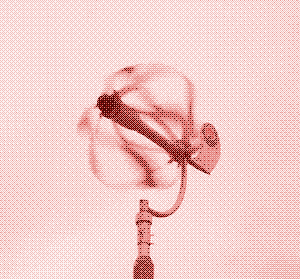
The problem is not the windmill - it is the wind
Small windmills have been around for some decades, but in recent years the focus has shifted on developing their potential use in an urban environment (where most of us live). It’s difficult to keep track of the numerous proposed new designs, meant to be placed on the roof or on a mast in the garden.
Small windmills in built-up environments are a remarkable trend. Through the ages, windmills have always demanded a free flow of strong wind. They are preferably placed on an open plain, as high as possible, with no obstacles around. In cities, however, this is not the case. Yet, the designers of urban windmills all claim to have invented a “revolutionary” windmill, especially created for the low wind speeds in those environments.
Most of these windmills are not yet commercially available, which makes it hard to verify whether or not the claims of the designers are justified. The few that are include the “Energy Ball”, a product from the Netherlands which is also sold in the neighbouring country of Belgium. The windmill is made by a company named “Home Energy” (read a snippet of their website in English, French and Swedish).
Energy Ball, which can be placed on a roof or on a mast in the garden, is said to deliver more energy than a traditional windmill, and to generate electricity at a very low wind speed of 2 metres per second (Beaufort 2).
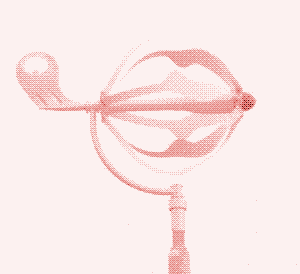
The secret of these results is the “Venturi-effect”, inspired by river currents. Thanks to the “unusual and exceptional aerodynamic characteristics”, the machine creates a wind flow pattern that “converges first and is then accelerated through the rotor”. Furthermore, Home Energy labels the Energy Ball as “beautiful” and “noiseless”, addressing two important objections against urban windmills: noise pollution and visual intrusion.
Energy output: 100 kWh per year
All this sounds promising, but do the numbers add up? Home Energy states that the Energy Ball can deliver 500 kilowatt-hours of electricity per year, or 15 to 20 percent of the electricity use of an average Dutch household (which consumes 3,567 kWh per year). But these claims are based on an average wind speed of 7 metres per second (Beaufort 4) – highly optimistic.
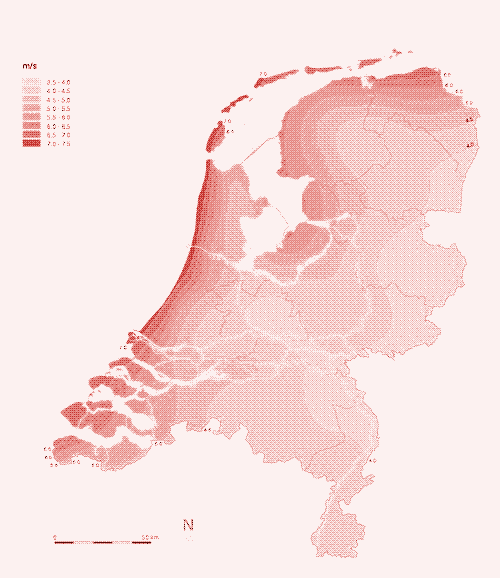
If you look at the wind map of the Netherlands below (this data is nowhere to be found on the Home Energy website) you can see that the average wind speed on land (at a height of 10 meters) is only 4.3 metres per second. Holland is also a notoriously windy country. Only a small part of the coastline receives an average wind speed of 7 metres per second. In Belgium, the average wind speed at the coastline is nowhere higher than 6 metres per second.
At an average wind speed of 4 metres per second, the yearly electricity output of the Energy Ball only amounts to 100 kilowatt-hours (this figure comes from their website). This is not 15 to 20 percent, but just 3 to 4 percent of the yearly electricity use of an average Dutch household (100 kilowatt-hours corresponds to a continuous power consumption of 11 watts). Obstacles like trees and buildings can make the yields in specific locations even lower than that.
Payback time: 50 to 750 years
The very low power output of the Energy Ball would not be such a problem if the machine was cheap. After all, as Home Energy states, the windmills can be placed in series. However, the price of one Energy Ball, everything included, is around 5,000 euro (7,300 dollar). If our average Dutch household wants to cover 15 percent of their energy use by wind energy, it needs at least 5 Energy Balls. Total cost: 25,000 euro (36,500 dollar). If the household wants to cover all its needs by wind energy, it needs to buy 30 Energy Balls for a price of 150,000 euro (219,500 dollar).
The energy output of the Energy Ball is based on an average wind speed of 7 metres per second, which is unrealistic in cities
How much time does it take to earn back the initial investment of an Energy Ball? Home Energy is careful enough to state on their website that the payback time depends on “the initial investment, the yearly yield and the prevailing price per kilowatt-hour”. However, it would be fairer to state that the Energy Ball will never pay itself back.
Rates per kilowatt-hour of electricity fluctuate largely around the world and even within countries, but let’s assume a price of 0.20 euro, the relatively high average electricity price in the Netherlands (that’s 0.29 dollar – three times the price of electricity in the US). If you also assume Home Energy’s optimistic average wind speed of 7 metres per second (which corresponds to an output of 500 kilowatt-hours) then the payback time is 50 years. Take a more realistic average wind speed of 4 metres per second and the payback time becomes 250 years. At the average US electricity price, payback time is 750 years.
Warranty of 2 years
Of course, electricity prices may rise, and the Energy Ball may become cheaper to produce. If you assume an electricity rate of 1 euro (1.46 dollar) per kWh, then the Energy Ball pays itself back in 10 years (at the most optimistic wind speed of 7 m/s) or in 50 years (at a more realistic wind speed of 4 m/s). If Home Energy can also cut the selling price in half, then we are talking about a payback time of 5 years (at high average wind speed) or 25 years (at realistic average wind speed). Even in these hypothetic cases, however, payback time is speculative.
According to the manufacturer, the life expectancy of the Energy Ball is 20 years. That’s just a promise. The machine comes with a warranty of only 2 years. Solar panels have a warranty of at least 20 years. Contrary to solar panels, windmills consist of mechanically moving parts, which means that there are more breakage possibilities.
Embodied energy
Advocates of personal windmills sometimes admit that yields are not very impressive. But they state that buying a small windmill can still be a good choice from an ecological viewpoint, even if it is crazy from a financial perspective. This sounds rather reasonable, but something is forgotten here: the energy needed to manufacture and install these machines.
Urban windmills are not as energy-intensive to produce as solar panels, but since they also have much lower yields and much lower life expectancies than solar panels, their energy footprint is even worse. According to a recent report by the UK Carbon Trust, windmills in urban environments will almost always have an energy payback of more than 20 years.
In other words: small windmills in cities will never deliver as much energy as was needed to manufacture and install them. Installing an urban windmill will actually harm the environment. On the other hand, the energy payback time of a large windmill is less than one year.
Wind physics
Ecotech boffins will be fast to reply that the Energy Ball might be a failure, but that it does not mean that other concepts can not do better. Unfortunately, the problem is not the windmill – it is the wind. The Dutch have a long tradition of designing windmills, so there is a big chance that the Energy Ball does better than its competitors.
Doubling the wind speed increases wind power 8 times. How you design a windmill hardly makes any difference
Wind speed has a much larger influence on energy output than the design of a windmill. To calculate wind power you have to multiply the density of air, the swept area and the cube of wind speed. Doubling the rotor radius of a wind turbine increases wind power 4 times.
Doubling the wind speed increases wind power 8 times. At an average wind speed of 7 metres per second, a windmill delivers 5.36 times more energy than at an average wind speed of 4 metres per second. How you design your windmill hardly makes any difference.
Cut-in speed
At lower average wind speeds, even very small changes can make a huge difference. According to the Carbon Trust the cut-in speed of a small wind turbine (the moment it starts producing energy) is between 3 and 4 metres per second. This is close to the average wind speed on land in rather windy countries like Belgium and the Netherlands.
A test by the Carbon Trust (see graphics below) showed that a windmill receiving an average wind speed of 4.5 metres per second produced 7 times more energy than a windmill receiving an average wind speed of 3 metres per second – because the latter is not operating most of the time since it does not reach its cut-in speed. While large wind turbines have an average capacity factor of 28 to 35 percent, small windmills only achieve 15 to 20 percent of their capacity in rural areas and only 10 percent in urban areas.
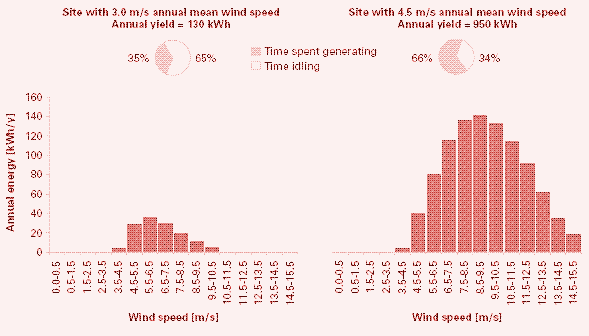
Home Energy claims a lower cut-in speed of 2 metres per second, but that’s just bogus. And they know it: in the Q&A section of their Dutch website they admit that the windmill starts rotating at 2 metres per second, but only starts delivering energy at 3 metres per second.
Height
An important factor to do with wind speed is height: wind speed rises and is more constant the higher you go, which is the reason why traditional windmills are built ever larger and why the concept of floating windmills is attracting so much interest. It is also the reason why the potential of small windmills is generally overestimated. When you are shown a wind map, the chance is big that it concerns a map of wind speeds at a height of 75 metres or more, indicating the potential of traditional windmills. Wind maps showing the wind speed at a height of 10 metres are much harder to find.
Urban windmills are - by definition - located close to ground level, where wind speed is as low as it can be. Of course, you can place your urban windmill on a mast of 100 metres, but such a construction would make the carbon footprint of the machine even worse. Placing windmills on a skyscraper is of not much help either: in this case you have much higher wind speeds but the roof is way too small to set up a windmill for every household that lives in the building.
What we need
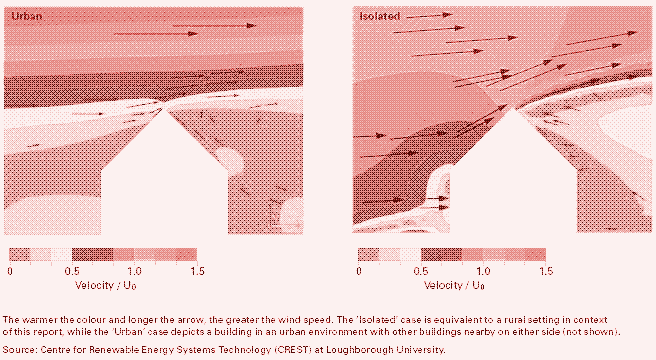
The fundamental problem of urban windmills is that they harvest electricity from an inferior energy source. On a rooftop in a built-up environment, wind speed is low and freakish. And while you can think of a thousand ways to change the design of an urban windmill, it is impossible to change the wind itself.
Most wind maps show wind speed at a height of 75 metres or more
Installing one big windmill will therefore always be a better choice (economically as well as ecologically) than installing many more small wind turbines instead. Sad, but true. This is not the case with solar panels. Other buildings (or trees) might cast shadows on solar panels in a city, but if that can be avoided, capturing solar energy from your roof is not less efficient than capturing solar energy from a larger solar plant.Since it is impossible to substantially improve the power output of urban windmills, the only hope for decentralised wind energy is to produce machines which are much cheaper and more importantly leave a much smaller carbon footprint and/or have a much longer service life.
Update : Small windmills put to the test
It seems that we have been too friendly for the Energy Ball. A real-world test by the Dutch province of Zeeland (a very windy place) confirms our analysis that small windmills are a fundamentally flawed technology. The Energy Ball has the worst score of all, with an energy yield of only 73 kWh per year, even less than our worst case scenario. Other micro wind turbines did not do much better. Read the article here.
Reactions
To make a comment, please send an e-mail to solar (at) lowtechmagazine (dot) com. Your e-mail address is not used for other purposes, and will be deleted after the comment is published. If you don’t want your real name to be published, sign the e-mail with the name you want to appear.
Reactions
thomas
WOW WHAT AN ARTICLE, what a bunch of crap, LIES HALF TRUTHS AND IRRELEVANT INFO, first, micro wind turbines don’t cost 26k for a residential solution, TRY 2-3k, you can get an Air X for $500 if you shop, it puts out 400w @ 26 mph wind speed but around 150-200 at 10-14 mph, 4 would cost you 2k and add another 1k for poles, mounts, wires and a charge controller. AS usual you bozo’s go with your either or arguments on wind or solar, you WANT BOTH, their complementary, I have 40 solar panels(12K) and three air X micro wind turbines, I live in a suburban area, southern CA, together they supply 90% of my electric. I could give a $h1t how much energy it took to make them. All I know is I break even in 7 years, I’ve had them for 3 so I have 4 to go.
Kris De Decker
Don: for an update of this article, including tests of almost 40 different types of small wind turbines, not only in the Netherlands but also in the UK, see here:
http://www.theoildrum.com/node/6954
Kevin Coleman
From what I know about sustainable energy generation you have to take into account the cost of all the materials and their extraction required for the construction of your chosen device ‘before’ you can say whether its a good or bad method. A combination of solar and wind generation seems to be the way forward but it is still expensive in environmental terms. Need to force the energy generators to invest more in research and development of cleaner alternatives.
However from the previous comments it seems to me that some folks ‘want their cake and eat it’ and ‘up’ everyone else’s.
Nowt like a caring, sharing community is there?
Interesting article though.
Jim
It is not cost effective or environmentally neutral as is, but it can be. It is absolute genius if natural materials were used. Large windmills capture only the wind energy from the the air directly surrounding it. Thousands of small mills “combing” the air would be much more efficient.
Forcemaster2000
You’re obviously in the pay of one of the major power companies. It’s sad that people like you feel it’s necessary to spread dis-information so that people will be less likely to try new technology and instead keep paying in their money to the mega corporations.
kris de decker
@ Tommy
Large windmills are not in residential areas because there’s always a chance of a blade failure: https://www.youtube.com/watch?v=CqEccgR0q-o
solarboy
I personally lived for 10 years in a bus with 2 50w BP solar panels and a 250W Aerogen wind generator. The panels were great an enabled us to live from March till October in the UK without any extra power. I spent many days watching the ammeter from the wind generator on windy days barely moving. Very sad. Very good article and I agree with you wholeheartedly. Also, have you seen these pocket fold out solar chargers for mobile phones etc….about as useful as a chocolate kettle.
aly
I was just browsing the web researching the possibility of putting up my own windmill (small) on my on-acre lot in the desert (very windy, 3,000ft altitude.) Totally bummed. On the bright side, it looks like I couln’t afford it anyhow. lol
John
There is a way to improve the environmental benefit of an urban wind turbine. You have the manufacturer leave the generator out of it.
Brent Eubanks
Environmental Building News, the most reputable and oldest of the green building industry magazines, has an article this month that comes to much the same conclusion:
http://tinyurl.com/ch5tgc
kdd
Dimitri, you are right to state that it takes fossil fuels to produce fossil fuels (more and more, actually, see the concept of “Energy Return On Energy Investment” or EROEI).
However, this does not change the conclusion of the article at all, since I do not make a comparison between fossil fuels and small wind turbines. I am only talking about small wind turbines.
If you invest more energy than you get out of the process, a technology is worthless - whether it is a wind turbine, a nuclear plant or a coal plant.
Wind-turbines on the roof of high-rise buildings have been tested in the UK, with disappointing results. See this report:
http://www.warwickwindtrials.org.uk/2.html
Dimitri Galani
The article was great: simple, well written and logical.
However, you do not appear to consider the fact that producing fuel oil -and transporting it the power stations- also uses significant amounts of energy: 1)drilling 2)extraction 3)Refining 3)transpotation and 4)distribution. There are also a significant losses on the power grid which ’transports’the energy to the households.
Taking all these factors into account may yet affect the equation.
It would be useful to consider whether wind-turbines on the roof of high-rise buildings would be efficient, as the air flow is certain to be more powerful up there.
cloud ponderer
The author has apparently missed at least one new innovation, available right now, at least in the U.S.) for a-do-it-ourselves-guide installation. I think the author needs a bit more faith in the POWER OF DESIGN. Urban wind is not impossible, we just need to stop trying to transpose one solution onto a different problem. ENGINEERS NEED TO LEARN TO REEXAMINE THE PROBLEM AND USE A FRESH—TOTALLY FRESH—PERSPECTIVE! That has been done beautifully here, utilizing the SPEED AT THE ENDS OF THE BLADES (rather than at the center, where speed is slower) and eliminating the weight, drag, complexity and cost of a gear box:
http://www.earthtronics.com/honeywell.aspx
Peter Bird
Shame about the negative and abusive attitudes of some of the feedback. The simple point being made is that small wind gens are nowhere near as efficient as large scale units. The criteria for efficiency - in this article - being how much energy is use to produce the equipment compared with how much it produces. Anyone understands the simple principles of capitalism will relate.
What I failed to extract is the break even point. Does it take 10,000kw to produce a small wind gen ? if so and that gen is producing 1000kw per annum then after ten years the equipment is in the positive.
Along with this we need to consider how much power is being consumed through other means - including large windmills.? That may change the dynamics of the equation whereby small wind gens are in the positive after lets say seven years. If we then figure into the equation, the power consumed in creating the equipment for the ‘other’ power sources. then the dynamics shift even further whereby the small wind gens might well break even after just one or two years.
Personally I found this and the linked articles interesting and thought provoking. Perhaps only short of exploring the full breath of possibility and conclusion, but hey they are volunteers not mega buck businesses. I thank all those who contribute in a positive way. Criticism can be constructive or destructive - please let’s stop belittling others - think about what you wrote and the way you write it.
Best regards, Pete
Pieter
Urban wind turbines are often put forward by opponents of large scale wind turbines. It is good that you to expose this as a red herring.
Don
Kris,
While I do agree that many small turbine designs do not do well in an urban environment, you seem to have focused on one design from Home Energy and located that one design in Belgium or the Netherlands.
Since this article was written 2 years ago, may I make a suggestion that you revisit and learn a bit more about the varying power outputs of other designs? Honeywell has a new design that begins producing energy at a much lower wind speed than you keep quoting is necessary for the Energy Ball (which I agree is not worth the money or energy spent on creating it). That makes a difference in Urban areas.
It may be that turbines are not efficient enough in urban areas. I lived in Chicago for a number of years, and I believe that the even the occasional winds that roared through the city could be exploited for their energy. Many buildings had ropes and handrails so that you would not blow away.
earthman
I actually just started working for a dealer of the Energy Ball so I’m doing some research. But I guess my comments could still be biased. :)
I think what is not mentioned by the author of this article is that one or more small wind turbines, combined with solar panels, may actually turn an incomplete renewable energy solutions into a complete solution.
The benefits of even a small amount of power generation during the night, when we typcally use less power anyways, or on a cloudy day, could actually turn an inviable solution into a viable solution for many many people.
You may think this is false, if it is like you say, that it takes more energy to produce than it will ever return. Because you could just get the same amount of power from the grid.
HOWEVER, it really depends on your exact location and the cost of hooking up a new home to the grid just for example. Just one minute outside the city limits and you’re probably looking at a heafty charge to be connected and lot of energy to get you hooked up unless the tax payer pays for it, I honestly don’t know.
But what about camps 5 or 10 minutes away, and smaller towns that can’t afford the installation and maintenance of power lines. And wouldn’t it be nice to build virtually anywhere you want instead of sticking houses six feet apart.
But I think the biggest thing that most people might fail to consider is that once you have the product, you can probably maintain it and refurbish it for hundreds of years! Sure some things may need to be replaced but it’s not going to completely disintegrate in 20 years!!! LOL
If twenty years from now all you have to do is replace a coil and/or some magnets, maybe even a blade or two, but then have it run for another 20 years, and then your kids do the same and their kids!
And then you have to also consider that the energy to produce it may have actually been or will eventually be supplied by thousands of solar solutions that were made viable by what, you guessed it, wind turbines!!!!!!!! And who knows, if the construction process is actually 70% manual labour or if it’s eventually lowered by investing in the company that creates it then how much cole did it or will actually burn?
Obviously, if your home is already connected to the grid, and you’re in a an area with very little wind, I won’t say it’s can’t actually be a bad solution, because I honestly don’t know and I’m not a liar. But that doesn’t make it a bad product that has completely no use or benefits.
ALSO, in many cases, raising the Energy Ball’s height might be all you need to improve it’s roi. And last I checked, once you invest in a pole, it’s going to stand for an extremely long time, unless you have a little too much to drink and ram your car into it. LOL
You also have to remember that the Energy Ball also solves the issue of noise issue. And it does come in a large version now. This article seems rather old and doesn’t seem to mention the V200 model.
Obviously I think the real benefit of small wind turbines is if you want to get off the grid completely. There’s no bill to worry about, no paper invoices in your mailbox, no blackouts to worry about which could easily increase in the near future (not scare tatic just my opinion).
Basically it’s an investment.
Palomar bob
All wind turbines should be required to show kwh/day; kwh/mo; kwh/yr only
Grid requirments ( cb amps ) ( volts ) etc
Never any estements of anykind anywere
Maps showing kwh/?? For that make/model
On Map of zeeland you would find ( 73kwh/yr energy ball v100 ) ( 330kwh/yr airdolphin ) ( 578kwh/yr passaat)
( 2,687kwh/yr montana ) etc
On map of northfield, minnesota ( 4,000,000kwh/yr micon 82 )
Coralocean
Hello,
We are 6-7 years after this article was send out. At the time we can consider it was still very new in people’s mind.
now things have changed. Technology in this particular sector has made huge improvement during the last decade. A lot of small companies have shown up with nice light green projects.
so question is, wouldn’t it be nice after to have a new article on this subject based on these new technologies that poped up ?
cheers.
Dairokkan
Well design of energy ball is strange and I agree that wind power plants in that scale are waste of money, but maybe something bit bigger on high buildings could give reasonable power output.
For some time I was thinking about clothing power generating facilities into “traditional” clothes, just put gearbox and generator into windmill. I think it will make smaller damage of landscape than modern wind power plants, especially on land.
LR
Ronyon:
If you’re going to go to the trouble of setting up a wind generator, take a few hours and carve a decent set of turbine blades. For two blades, I’m sure two or three hours with a 2X4, a drawknife, a plane and some sandpaper would result in a far more efficient blade that was also more robust. The ceiling fans I’ve seen don’t have any twist in the blades, meaning that large parts of the blade will be either stalled or causing net losses. Furthermore, I haven’t seen many that have a cross section anything like that of an airfoil. Do a web search on “dannysoar prop carving”. I’m suggesting something similar but on a larger scale. One thing to remember, though, is that a turbine will have the flat side on the front of the blade, not the back. Also, for, say, a 6 foot turbine made from a 2X4, balancing is going to be a lot more important.
Water heaters, if you take showers often, are going to take quite a bit of energy. So you’ll need a relatively large turbine. I’m talking over 1,000 kWh per year, if your winds are steady. A heat pump style water heater might reduce the requirement. And if you also run a dehumidifier, the head pump water heater will reduce the power your dehumidifier consumes. Using electricity from a wind generator to heat water with resistive elements wastes a lot of energy.
First, you have to convert that mechanical energy to electricity. Some of that energy will be released as heat, but not inside the water heater. I’d say at least a quarter if you’ve done all your engineering perfectly. If not, considerably more heat. (I’m not counting the heat from the aerodynamic inneficiencies of the turbine itself, since some of that is inherent in any wind turbine. OTOH, if you’re using a ceiling fan…..). If you put your turbine directly over the tank, you could drive a plunger or propeller inside the heater, which would heat the water. Or use a driveshaft to run your generator INSIDE the heater, so that you harvest the waste heat. Assuming you can keep the water out of the generator, anyway. That’s all a bit tricky, of course.
For hot water, direct solar heating of the water will be better. Ideally, you could use the heat from the back of photovoltaic panels, thus also cooling the panels. But even if you just use aluminum or copper sheets with tubes with water running through them, that will be more effective, I think. The low grade heat generated this way would be hard to generate electricity with, but just right for a water heater. Save the electricity for lights, electronics, etc. Hmmm…I’m imagining a combination water heater/high powered computer. ;-)
BTW, I’m the same LR that wrote comment number 27. I’d forgotten it and was all set to write the same things again.
Caveat: Maybe if you can skip all the fancy electronics and just run whatever current you get through the water heater coils, you can skip a lot of work building the equipment. You won’t even need a rectifier. Also, model airplane brushless motors are cheap these days. So if you can spin them at efficient speeds, it might be a good way to go. I wonder if there’s a way to use the electronics speed controls for those motors to regulate the resistance the turbine is pushing against to maintain the most efficient speeds. I’ve that a good set of turbine blades would be most efficient when the tips are going about 10 times the wind speed. The speed control might be able to maintain that ratio without having to have variable pitch or something.
I’d better sign off. I’m supposed to be doing something else!
Ronyon
There are some nice DIY windmills made from discarded ceiling fans and rare earth magnets. The embodied energy and cash i nvestment is small, the out put modest,but I think they would useful wired to a water heater element to take over the job of maintaining tank temperature.
Tommy
I often find myself thinking about articles on this website long after I have read them. I don’t understand some of the parameters that seem to be assumed when discussing urban windmills. Why do they need to be small? Having looked at the article on direct heat generation through hydraulic braking, I’m envisioning large windmills on the top of skyscrapers in coastal cities like Chicago for hot water heating in the summer and a supplement to the boiler in the winter. I imagine the drag created by a large windmill could be very substantial, and I’m not sure how that could be accommodated by existing structures, but it seems like these large residential installations take a lot of energy to heat and a mechanical heating solution could be efficient.
Kris De Decker
@ Tommy
Large windmills are not in residential areas because there’s always a chance of a blade failure: https://www.youtube.com/watch?v=CqEccgR0q-o