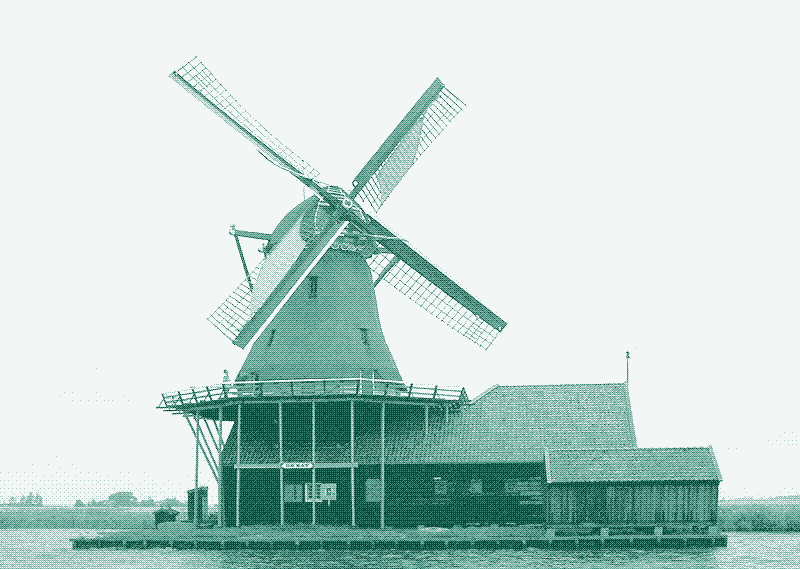
In the 1930s and 1940s, decades after steam engines had made wind power obsolete, Dutch researchers obstinately kept improving the – already very sophisticated – traditional windmill. The results were spectacular, and there is no doubt that today an army of ecogeeks could improve them even further. Would it make sense to revive the industrial windmill and again convert kinetic energy directly into mechanical energy?
The Netherlands had 5 times more windmills in 1850 than it has wind turbines today
More than 900 years ago, medieval Europe became the first large civilisation not to be run by human muscle power. Thousands and thousands of windmills and waterwheels, backed up by animal power, transformed industry and society radically.
It was an industrial revolution entirely powered by renewable energy – something that we can (and do) only dream of today. Wind and water powered mills were in essence the first real factories in human history. They consisted of a building, a power source, machinery and employees, and out of them came a product.
Windmills and waterwheels were not new technologies – both machines appeared already in Antiquity and the ones used in the early Middle Ages were technically no different from those. However, ancient civilisations like the Greeks and the Romans hardly used them, possibly because of religious reasons and because of a large enough reservoir of human slave labour.
Water versus wind
Water powered mills were – overall – more important and numerous than windmills. This is logical since they are a simpler and more reliable technology; the flow of a river might change according to the seasons, but generally a river always contains water. Moreover, by making use of canals and sluice gates the flow of water could be precisely controlled to provide the speed or load required by the gearwork inside the factory.
The wind, on the other hand, does not always blow. When it does, wind velocity and direction can change at any moment and windmills had no efficient method to control the strength of the wind – at least not in early medieval times. Water powered mills appeared in Europe in large amounts from the end of the 11th century onwards and only 200 years later almost all available energy in rivers and streams was put to use.
However, not all regions were suited for watermills. The reasons could be that they did not have sufficient water resources (like Spain), that they were too flat and their rivers did not have enough flow (like the Netherlands and the downlands of England) or that rivers generally froze during winter (like in Scandinavia, Russia and parts of Germany). In these countries, windmills appeared in the 13th century, possibly earlier, and spread fast. Later, also regions that had abundant water resources constructed windmills, to relieve the pressure on rivers and streams.
How many windmills?
The amount of windmills in early medieval times remains unknown, because the few inventories that could be studied do not distinguish between water and wind powered mills. For instance, we know that there were between 10,000 and 12,000 mills in the UK in 1300, but we do not know how many of them were wind powered (it must have been a minority).
All we have are data on individual windmills, which start to appear at the end of the 1200s. Only in the 1700s and 1800s, when windmill technology really caught on, more accurate inventories appear.
In 1750, there were 6,000 to 8,000 windmills in the Netherlands, in 1850 there were 9,000 of them. For comparison, this is almost 5 times as much as there are wind turbines in the Netherlands today (1,974 turbines as of September 2009). In the UK there were 5,000 to 10,000 windmills in 1820. France had 8,700 windmills (and 37,000 watermills) in 1847.
The total amount of wind powered mills in Europe was estimated to be around 200,000 (at its peak), compared to some 500,000 waterwheels.
Germany had 18,242 windmills in 1895 (compared to around 18,000 wind turbines today) and Finland had 20,000 windmills in 1900. Portugal, Spain, several Mediterranean islands and many Eastern European and Scandinavian countries had many windmills, too.
The total amount of wind powered mills in Europe was estimated to be around 200,000 (at its peak), compared to some 500,000 waterwheels. Windmills were built in the countryside and in cities, and even on the walls of castles and fortifications in order to catch more wind. Initially, the only applications of windmills were the grinding of grain and (to a lesser extent) the pumping of water and the draining of lowland areas (for which they were connected to a waterwheel working in reverse – the scoopwheel - or to an Archimedean screw).
Bread and oats were the staple diet of the Middle Ages (meat, fish and vegetables were only available to the rich) and all that grain had to be crushed or ground. It took one person with a hand mill two hours a day to grind enough flour for an average family. Corn windmills were also used to make Dutch gin and other liquors.
The grinding of grain remained the most important use of windmills - as late as 1900, the entire wheat harvest of Northern Europe was ground by windmills in the Netherlands, Denmark and Germany. However, around 1600 many new applications of windmills appeared.
New applications
Windmills were used for hulling barley and rice, grinding malt, pressing olives to olive oil, and pressing coleseed, linseed, rapeseed and hempseed for cooking and lighting. There were also cocoa mills, mustard mills and pepper mills (also used for other spices), even tobacco mills and snuff mills.
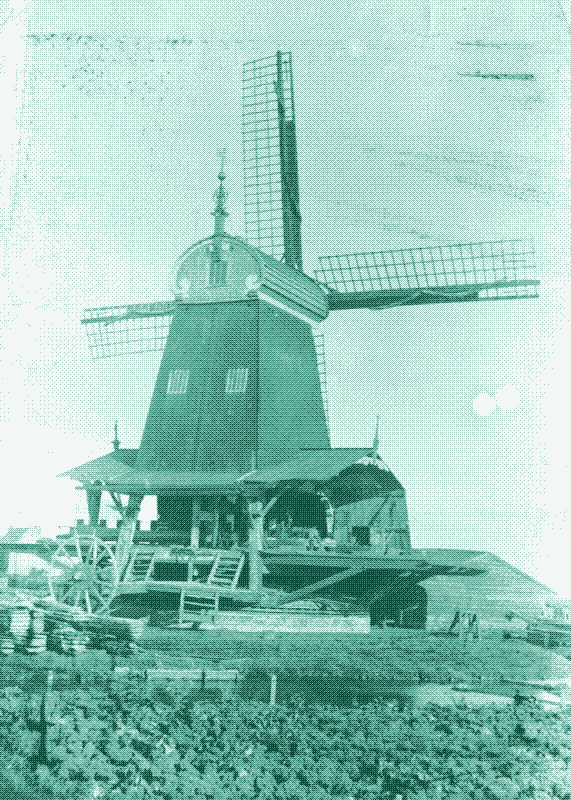
Besides food production, two other major applications of windmill technology were the production of paper (using ropes and sails from ships as a raw material) and the sawing of wood. Windmills were also crushing chalk (to make cement), grinding mortar, draining mines, ventilating mineshafts (and even a prison), polishing glass and making gunpowder.
Around 1600, many new industrial applications of windmills appeared: saw mills, paper mills, mustard mills, tobacco mills, …
Textiles were another industry in which wind power came to the rescue: windmills were crushing seeds from flax (to make linen), preparing hemp fibres (to produce ropes and sailcloth), fulling cloth (to create soft wool), making paint and tanning and dying animal skins.
The Zaan district
One of the most spectacular developments of industrial wind power technology occurred in the Zaan district, a region situated just above Amsterdam in the Netherlands. Although the area is surrounded by water, the potential of water power was limited because the land is as flat as it can be and so the flow of the rivers is low. The wind, on the other hand, is strong. Many of the applications of windmills described above appeared first (and sometimes only) in the Zaan district.
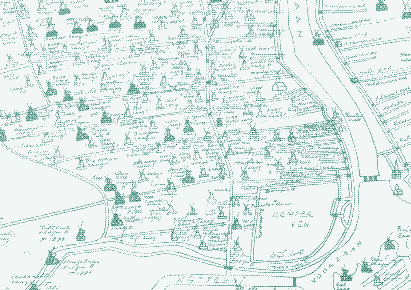
It is said that the region was the world’s first industrialized area. From 1600 to 1750, when the Netherlands became an important economical power, around 1,000 windmills were built and operated here. Mills were given names, just like ships.
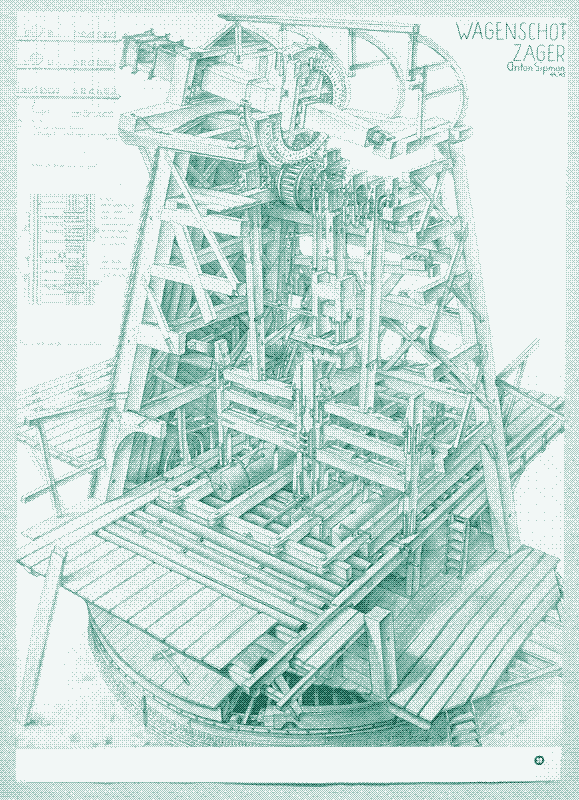
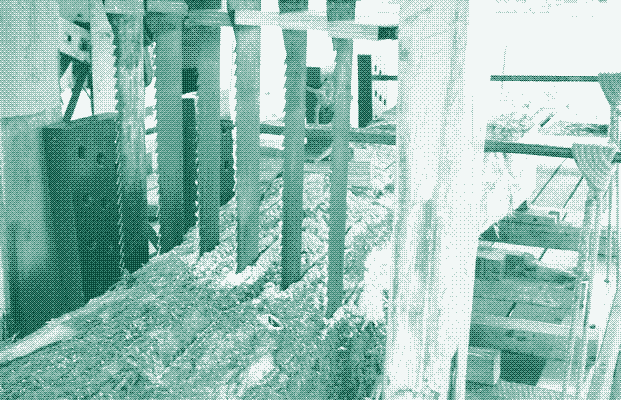
A vital element of the wind powered industry in the Zaan district was the saw mill. Wood was required to construct houses, sluices, ships and of course more windmills. Hand sawing was a very laborious task and windmills greatly reduced the time needed for the process. With hand sawing, 60 beams or trunks would take 120 working days, with wind power this only took 4 to 5 days (see picture further below, more here).
The first sawmill (“Het juffertje” or “The missy”) was built in the town of Zaandam by Cornelis Corneliszoon in 1596. By 1630, there were 83 sawmills north of Amsterdam, of which 53 were located in the Zaan district. The peak was reached in 1731 when there were 450 sawmills in the Netherlands, 256 of them in the Zaan district. Eventually even the crane of these mills, to haul up the timber, was driven by the sails.
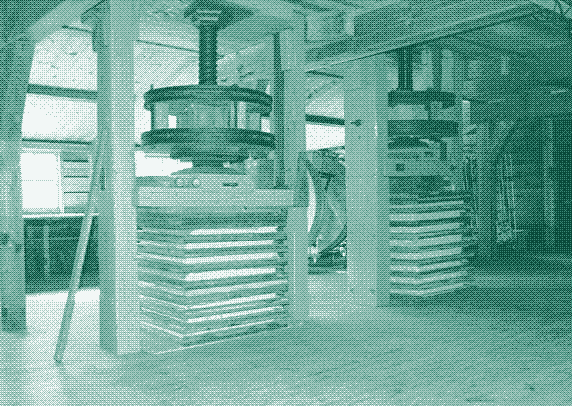
Another early industrial application of wind power in the Zaan district was the production of paper – this was, after all, the era in which the printing press appeared. The first papermaking windmill (“De Gans” or “The Goose”) dates from 1605 and by 1740 there were 40 of them. In the middle of the 17th century, the Dutch paper mill was substantially improved, which enabled it to make whiter paper and make it faster.
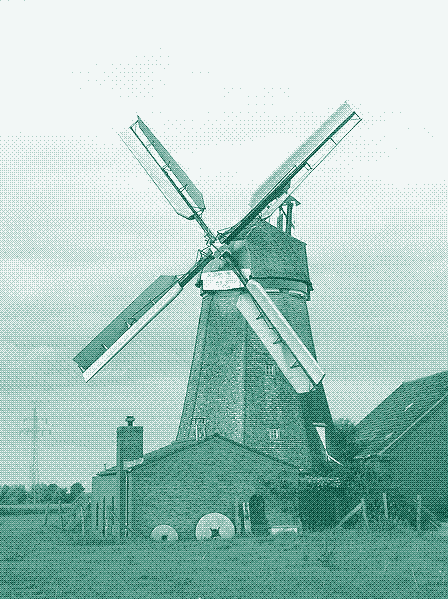
One remaining example is “De Schoolmeester” (“The Teacher”), built in 1692 (see the introductory picture and the interior below). Wind powered paper mills were rare in other countries, but water powered versions already appeared in the 11th century and became quite common – in England there were 417 of them in 1800.
In saw mills, even the crane to haul up the timber was driven by the sails
Other remarkable windmills in the Zaan district were snuff and tobacco mills (38 in 1795), oil mills (140 in 1731), barley hulling mills (65 in 1731), dyestuff mills (21 in 1731) and hemp mills (20 in 1731). The Dutch also built hundreds of windmills in the West Indies for crushing sugar cane. Relatively few of the 1,000 surviving windmills in the Netherlands are industrial windmills - drainage and corn mills remained economically viable much longer.
Backup power: animals
In many other European countries, similar functions were mainly performed by watermills. However, not all activities powered by waterwheels could be powered by sails. The fickleness of the wind made windmills unsuited for processes that required a very steady and reliable power output, like metal making, spinning, tool-sharpening or extracting minerals from mines.
In countries where the potential of water power was insufficient, some of these activities were powered by animals, mainly horses. Horses were also used as a backup power in long periods of calm, in order to guarantee delivery. For instance, in the Netherlands in 1850, there were 1,800 windmills for the grinding of corn, but also 1,300 horsemills for the grinding of buckwheat – a grain that required a more steady power source for grinding.
Post mills and tower mills
Early medieval windmills were simple machines, derived from waterwheels. During the following centuries, however, windmills became a very sophisticated technology. Windmills are much more complicated machines than waterwheels because wind velocity and speed change continually. Earlier windmills in Iran and Afghanistan were of the horizontal (vertical-axis) type, and thus did not have to adapt to changes in wind direction. But these machines, which were much less efficient, were never used in Europe.
Initially, medieval millwrights solved the problem of varying wind direction by positioning the whole mill on a central spindle so that it could be turned to face the wind. This was the so-called “post mill”. Around the 1400s, a second type of windmill appeared, in which only the cap and sails rotated and the body of the mill remained stationary. This was the so-called “tower mill”, which was later perfected by the Dutch.
Tower mills were also the dominant type around the Mediterranean, but these were less efficient machines with very different sails. Because it was stationary, the main body of a tower mill could be constructed from stone or brick, and thus they were more sturdily built. Both types continued to be in use, but many post mills were replaced by tower mills from the 1600s to the 1800s.
Turning the sails into the wind
These days, wind turbines are turned into the wind automatically by means of electronic equipment. When the wind becomes too strong, the electronics turn the blades out of the wind so they are not blown to smithereens. Medieval millwrights had no microchips and so they had to find another solution.
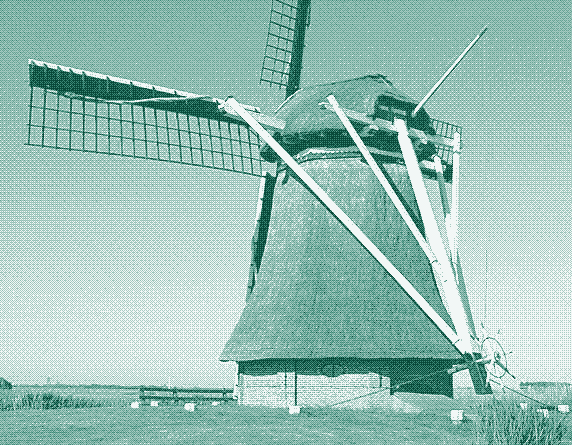
For many centuries, windmills were turned into the wind by mere muscle power. This was done by lifting a large tailpole at the back of the mill (hooked up to the tail ladder in the case of a post mill), moving it to the required position, and fixing it again at one of the twelve anchor posts sunk into the ground in a circle around the mill.
This was not an easy task, because the body of a post mill had to be turned with the weight of all the machinery inside. Some mills were equipped with a winch at the end of the tailpole, riding on a circular track, which made the task a bit easier.
The cap of tower mills was turned in a similar fashion, by means of a much longer tailpole - reaching to the ground or to the terrace in the case of a tower mill with a stage (here). Vent holes were drilled in the sides of the body of the mill – when the wind started blowing through one of these holes, the miller knew that wind direction had changed.
Adjusting the sails: a daunting task
Adapting to variations in wind velocity was even more challenging. The factory machinery inside the mill required a rather precise operating speed. For instance, corn mills worked best at 50 to 60 sail revolutions per minute. Once surpassing 80 sail revolutions per minute the grain would burn. Another risk was that when sails started turning too fast, the windmill could be destroyed.
Again, for centuries, the miller had to do this by hand. Basically, there were two ways to adjust to changing wind speeds. Minor differences in wind velocity could be absorbed inside the mill, by increasing or decreasing the load. For instance, in a corn mill, adapting to a higher wind speed could be done by widening the gap between the milling stones and adding more grain. Because the load is increased, the amount of revolutions of the sails remains more or less the same in spite of the higher wind speed.
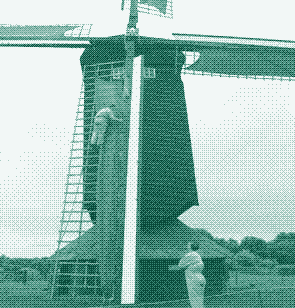
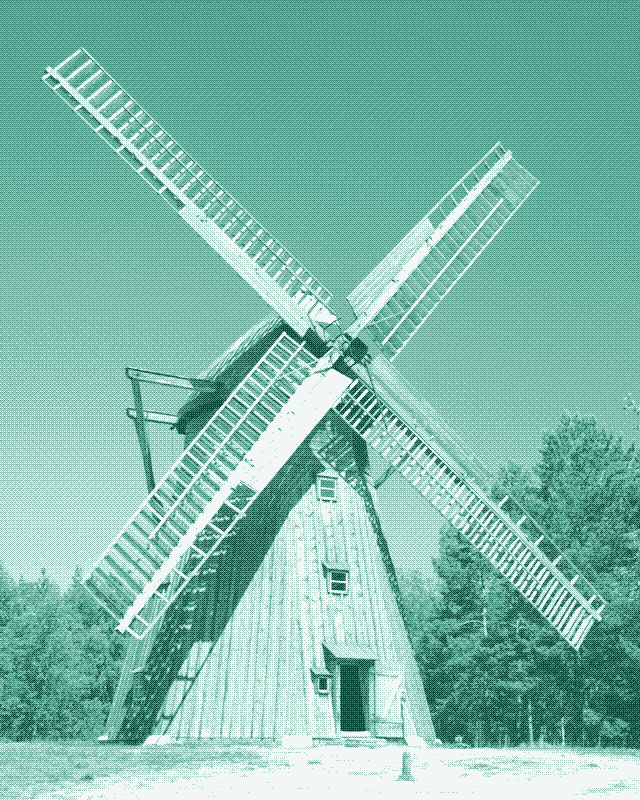
When the changes in wind speed became too large, however, the miller had no choice but to get out of the mill and adjust the sails. Traditional windmills were not equipped with blades, but with sails – mostly a wooden framework covered with canvas (in colder climates the canvas was generally replaced by slats of wood, which were easier to handle in freezing conditions).
Reefing two or even four sails, or reducing sail area were very effective methods to adjust to higher wind speeds, but these must have been daunting tasks in high winds.
At least two sails had to be brought within a vertical position and stopped so that the miller, climbing the sail, could take off the cloth. If the brake failed while the miller was in the sail, he would be in for a spectacular ride. Tying and reefing all four sails was also a standard procedure at the beginning and end of each working day.
During the second half of the eighteenth century, several complex but effective techniques were developed that made it possible for a traditional windmill to be left mostly unattended
During the second half of the eighteenth century, several complex but effective techniques were developed that made it possible for a traditional wind mill to be left mostly unattended, at least when it concerned changes in wind speed and direction.
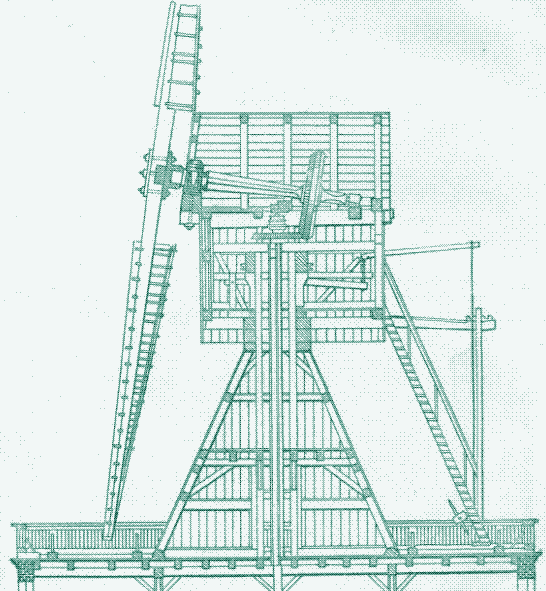
In 1745, the English blacksmith Edmund Lee invented the “self-regulating wind machine” or “winding”, a device that automatically adapted the positioning of the windmill to the direction of the wind. It consisted of a fantail (two fantails for larger windmills) and a gearwork (illustration below).
A fantail can be described as an auxiliary windmill that is mounted behind the main sails, at a right angle to them. If the direction of the wind changes, it hits the fantail, turning the mill until the main sails are again perpendicular to the wind.
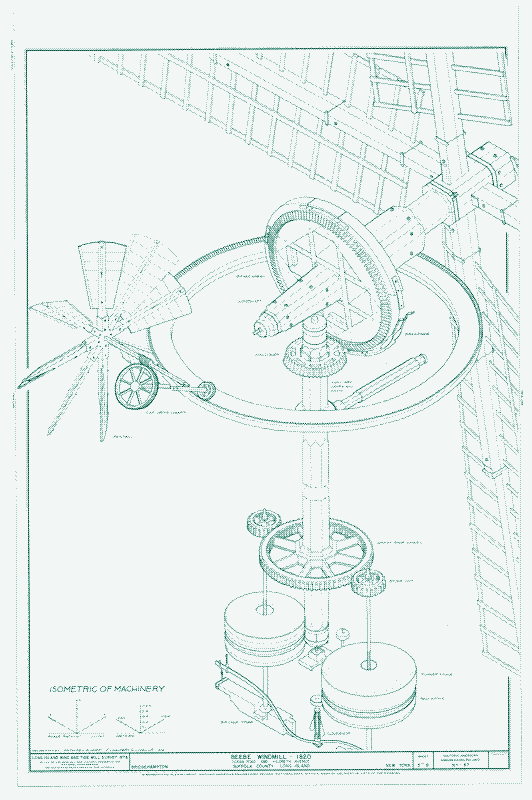

The fantail is geared down to a travelling wheel in the cap of the tower (in case of a tower mill, above) or around the building (in case of a post mill, see picture). Fantails were later used for wind-powered water pumps in the US, but because these machines were much lighter there was no need for a gearwork to turn them.
The winding not only made the handling of the mill much easier, it also augmented the power output. A substantial amount of power can get lost because of slight variations in the wind direction, but the miller did not always have the time (or the will) to turn the windmill following every minor change.
Automatic control: spring and patent sails
Around the same time as the fantail and winding were invented, mechanisms started to appear that were aimed at automatically adapting the sails to varying wind speeds. This led to the development of the so-called “spring-sail” in 1772, invented by Scottish millwright Andrew Meikle. On a spring sail, the sailcloth is replaced by dozens of shutters like those of a Venetian blind. Each shutter is controlled by a spring.
As the wind increases, it overcomes the force of the spring and the shutter will open, letting the wind through and slowing down the sails. The stronger the wind, the more the shutters will open. When the wind speed decreases, the shutters will be closed by the spring, again forming one uninterrupted surface. All of this results in having sails with a similar rotation speed at any wind velocity.
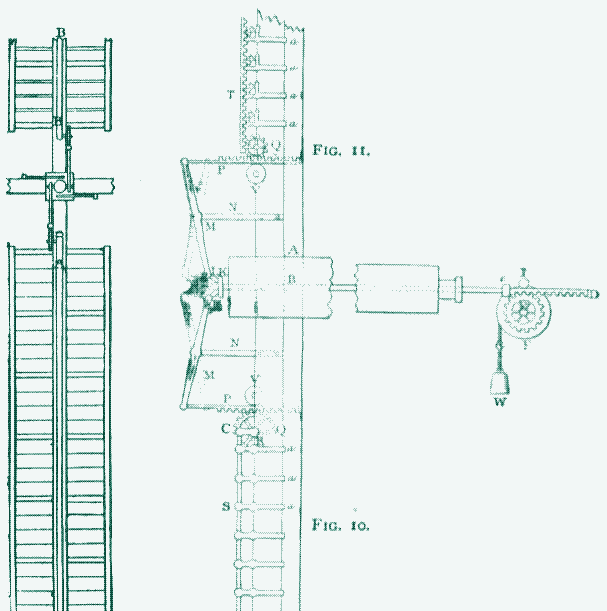

The problem with spring-sails is that the tensions of the springs (which are all connected to each other by means of a long pole) have to be adjusted beforehand depending on the expected wind speed and the power needed. Once set, it is impossible to make adjustments while the sails are turning.
This was solved in 1789 by Stephen Hooper, who introduced blinds that could be adjusted with a manual chain from the ground without stopping the mill (“roller reefing sails”). However, the system was too complicated. The final improvement to self-reefing sails came in 1807 when William Cubit attached counterweights to the adjustment chain of spring sails, making the control of the sails fully automatic without the complexity of the roller reefing method – these were called “patent sails”.
Berton sails
The only problem left was that patent sails had a lower efficiency than normal sails, and as a result it was common to combine two patent sails with two normal sails as a compromise between handling and efficiency.
In 1848, the Frenchman Berton replaced the many small shutters by fewer longitudinal shutters operating according to the same principle, an intriguing method that gave a sturdier construction and a better aerodynamic performance ("Berton Sails", see picture below).
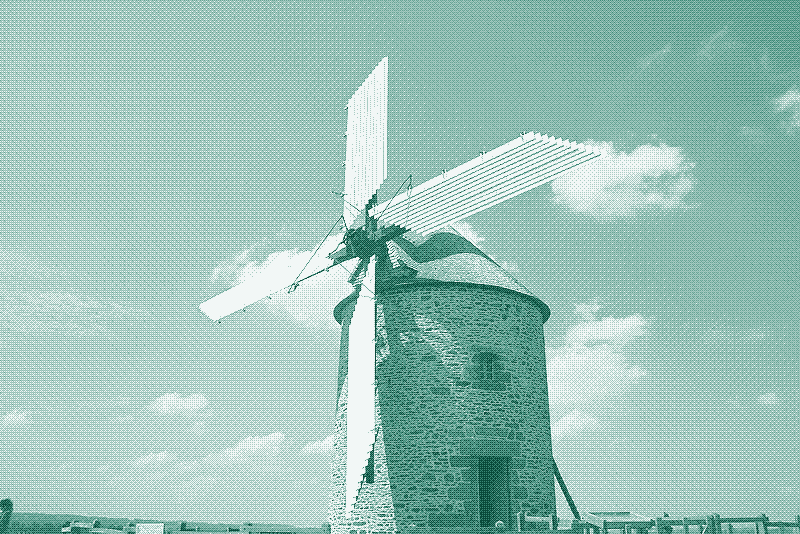
Moreover, the system could be adjusted by the miller from inside the cap of the mill. In 1860, Catchpole introduced air brakes, which were a very effective means to automatically slowing down the sails in a gale. Inside the mill, an automatic centrifugal governor replaced the manual adapting of the distance between the milling stones.
Of course, self-reefing sails and other automatic systems did not solve the problem of windless days - that is why the miller worked day and night when there was a good breeze. Millers were even exempt from Sunday’s rest.
As was the case with the fantail, self-reefing sails did not only improve the handling of the windmill, but also the power output. Because there was no longer a need for the miller to stand on the ground to fix or unfurl the sails, the wind shaft could be installed much higher so that the mill could benefit from higher wind speeds (the Dutch had solved this issue before by constructing tower mills where the sails could be reefed from a stage at a higher level).
Power output of a windmill
Another important improvement was the introduction of cast iron for the manufacture of the gearwork. This happened in 1755, only ten years after the introduction of the winding, by John Smeaton. For centuries, all gears inside the mill were made of wood. This resulted in serious energy losses.
Measurements performed by the Dutch in the 1930s, on a drainage windmill constructed in 1648, showed that the mill generated around 40 horsepower at the windshaft but only 15.6 horsepower at the machines – an efficiency of only 39 percent. Almost two thirds of the generated power was lost in the transmission. Drainage mills had a slightly higher efficiency of around 50 percent.
Windmills with wood gearings had an efficiency of only 39 percent
The use of cast-iron (and later iron) did not only improve the efficiency of the gearwork, but also allowed for the construction of larger windmills. The use of wood limited the diameter of the sails to around 30 meters – already common in the 1600s.
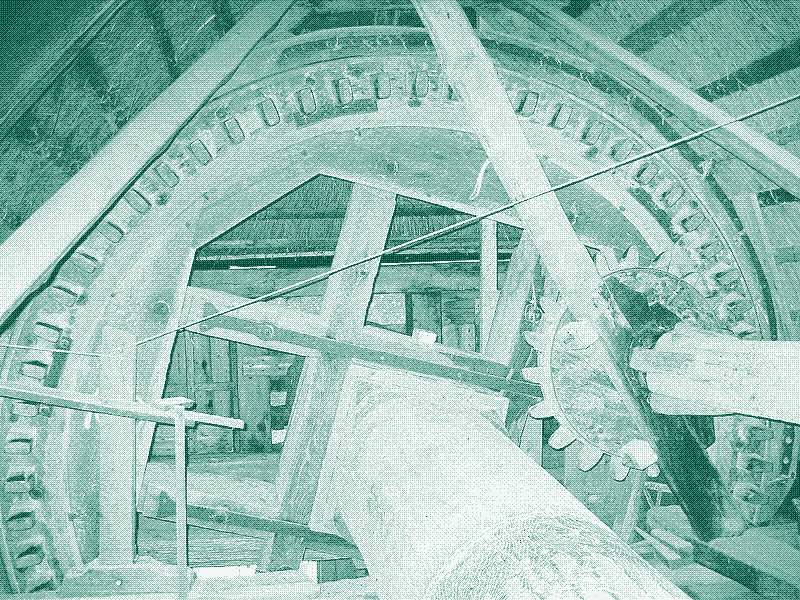
The maximum length of a stock (more than twice the length of one sail) was around 30 metres (100 feet) because there were no larger trunks available. Only in the second half of the nineteenth century iron stocks came to be used for the sails and for the windshaft.
Innovations came too late
Unfortunately, the many important improvements of windmill technology came too late. Already at the end of the 1700s, around the same time that these innovations appeared, the first corn mill switched from wind power to steam power – and to the black smoke that came with it.
Around 1850, steam powered mills became more common and the importance of windmills started to decline. To make things worse, fantails, self-reefing sails and iron stiffening were slow to catch on - in many countries and regions they were never even used.

Berton sails were only applied in France, patent sails were mainly used in England. Although iron stocks allowed for the construction of larger sails, that never happened. The highest tower mill ever constructed was made entirely out of wood. It was standing in the Netherlands and was constructed in 1899 (“De Hoop” or “The Hope” in Prinsenhagen, now the city of Breda). It stood 38 metres (125 ft) tall, with sails around 27 metres (88.5 ft) in diameter. The cap and sails were removed in 1929 but the tower is still there.
Largest windmill ever built
The two Dutch windmills with the largest sail diameter are standing in the Golden Gate Park in San Francisco, built between 1903 and 1905. The largest one, the “Murphy Windmill”, stands 29 metres (95 ft) tall with sails 35 metres (114 ft) across. The stocks were cut from one single log - the US had larger trees. But its gearwork is made entirely of cast iron and that shows: the mill pumped up to 150,000 litres (40,000 gallons) of water per day to irrigate the park. The Murphy Mill was replaced by an electrical engine some years later and fell into disrepair.
The decline of the windmill was slow, especially in the Netherlands - the Dutch even preferred windmills with auxiliary steam engines over fully steam powered mills. More than 6 million wind powered waterpumps (with annular sails) would be built in the United States between the 1850s and the 1930s, but elsewhere few windmills were erected after 1900. The attention shifted to wind turbines generating electricity, and that has remained so ever since.
Impressive improvements in the 1920s and 1930s
In the 1920s and 1930s, however, when windmills had stopped working almost everywhere in Europe, the Dutch started a research program that led to the final development of the classical windmill. In 1923, the “Dutch Windmill Society” was founded, with the mission to improve the performance of windmills generating mechanical energy. Among the members were famous millwright builders like the Dekker Brothers. The results were spectacular.
The maximum power output of a windmill was doubled from 50 to 100 horsepower at the end of the 1920s
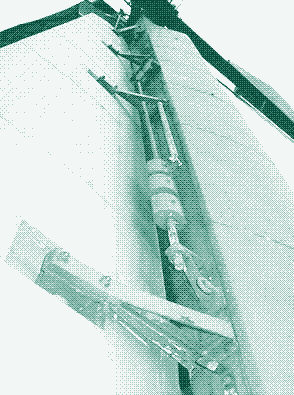
Through the application of aeronautical principles and the use of sheet metal (basically equipping traditional windmills with sails somewhat similar to the blades of modern wind turbines) the maximum power output of a windmill was doubled from 50 to 100 horsepower at the end of the 1920s.
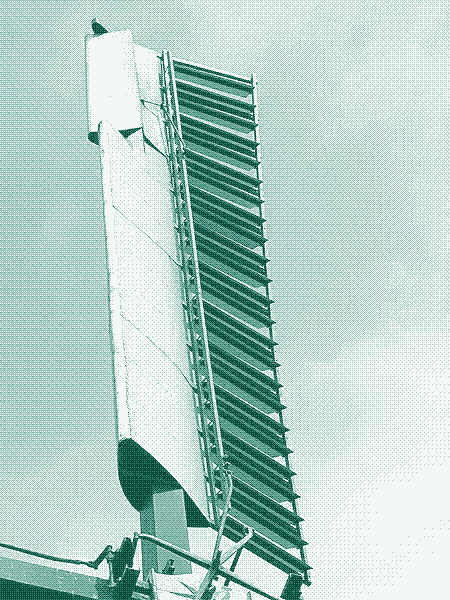
More than 70 windmills were equipped with the new “Dekkerized sails” during the following decade. Moreover, improvements in the gearwork slashed energy losses and allowed for windmills to generate much more power at lower wind speeds.
Doubling energy output
Tests conducted in 1939 by the “Prinsenmolen Committee” showed that an improved windmill would start to turn with a wind speed of 3.5 to 4 m/s (7.75 to 9 mph) compared to 5 to 6 m/s (11 to 13.5 mph) for the old design. At 5.5 m/s (12.5 mph) their power was found to be equal to that of a normal mill at 8 m/s (18 mph).
This meant that while a traditional windmill could be worked for around 2,671 hours per year in the Netherlands, the new streamlined design could be operated for 4,442 hours per year – more or less doubling the annual energy output.
The improved windmill had two advantages; a greater output at a given wind speed, and longer working hours by utilizing lighter winds. The gain was especially found in lower wind speeds, because with stronger winds the sails of the improved windmill had to be reefed sooner.
More improvements during the 1930s by Chris van Bussel, Kurt Bilau, G.J. Ten Have, Van Riet, P.L. Fauël, Sabinin and Yurieff led to a windmill, installed in 1940 and demolished in 1960, with up to two and a half times the power output of windmills with traditional sails: 125 horsepower.
Next, the Second World War stopped further investigations and after the war, like the rest of the world, the Dutch shifted their attention to the generation of electricity.
Revert to traditional windmills?
Today, windmills and waterwheels that convert kinetic energy directly into mechanical energy are considered obsolete, and while some have survived, few of them have any commercial function in developed countries. Wind turbines now turn renewable energy into electricity, which might later be converted back to mechanical energy.
Of course it is impossible to operate a flat screen television or a laptop with mechanical energy, but many other processes could in principle still be driven in that old-fashioned way. Grain still has to be ground, wood still has to be sawn, seeds still have to be pressed, but now we use electricity to drive machines that perform the same processes. This electricity can be generated by means of modern wind turbines, or other renewable energy sources, and that is the future that everybody has in mind.
Embodied energy
However, there are some reasons that might make it interesting to revert to a direct conversion from kinetic to mechanical energy. For one thing, it is more efficient because the intermediate step of generating electricity causes conversion losses. This means that we have to build less renewable energy plants to get the same work done. Planting a few million high-tech wind turbines, covering deserts with solar plants and developing a smart grid all sound attractive, but the most important question is whether there are enough material, energy and financial resources available to make those dreams ever come true.
Traditional windmills could be improved substantially with today’s knowledge and materials
Available data on the reserves of exotic resources required for many eco-technologies look grim, and some time ago it was heard that China (the main producer of important ecotech metals) plans to restrict the export of those metals. Windmills that convert kinetic energy directly to mechanical work could be operated without exotic materials.
High-tech traditional windmills
On a more positive note, traditional windmills could be improved substantially with today’s knowledge and fairly common materials. The gearings and sails could be made of steel or aluminum, which would seriously improve efficiency and also make windmills fireproof. Being made entirely or in large part of wood, many windmills were destroyed by fire. Of course, also the factory machinery inside the mill could be made much more efficient now.

Windmills could be built much larger and thus more powerful. To give an indication; in 2005, the Dutch built another traditional windmill, that generates electricity - the “Noletmolen” in Schiedam. It stands almost 42 metres tall with sails 30 metres across, slightly less than the Murphy Mill in San Francisco.
It was built for promotional purposes by a distillery (the town hosts 5 more historical mills built to produce Dutch gin). Although the mill is not really a “mill”, it is built according to a traditional design, but using high-tech materials and sails (picture above). The result is a power output of more than 200 horsepower at the windshaft. Take that, Energy Ball.
Ecotech treatment
Backup power for a traditional windmill could be delivered by an electrical motor instead of horses (or we could just work when the wind blows). There is no doubt that now, 70 years later, an army of ecotech geeks could still seriously improve the Dutch experiments from the 1930s. The results might not look as romantic as a traditional windmill, but very useful.
Of course, this is not a plea to eliminate electricity-generating wind turbines or even the electricity infrastructure altogether. But, some things might be more efficiently done with direct conversion of kinetic energy to mechanical energy.
Sources (in order of importance)
- “Power from Wind: A History of Windmill Technology”, Richard L. Hills, 1994.
- “Molens”, Frederick Stokhuyzen, 1962 (English summary here).
- “Research inspired by the Dutch windmills: An account of an extensive programme of research and development”, The Prinsenmolen Committee, 1966
- “Histoire générale des techniques”, Maurice Dumas, 1964
- “Molendatabase” – pictures and descriptions (in Dutch) of windmills in the Netherlands.
- “Natural sources of power”, Robert Steele Ball (1908)
- “Geschiedenis van de techniek in Nederland, de wording van een moderne samenleving 1800-1890”, H.W. Lintsen, 1992
- “Gevlucht”, Wikipedia Dutch
- “History of technology”, “Energy conversion” and “Windmills”, Encyclopedia Britannica.
- “An Encyclopedia of the History of Technology (Routledge Companion Encyclopaedias)”, Ian McNeil, 1990
- “Wind, Water, Work: Ancient And Medieval Milling Technology (Technology and Change in History)”, Adam Lucas, 2005
- “Handbook of Fluid Dynamics”, Richard W. Johnson, 1998
- “The windmill as prime mover”, Alfred R. Wolff, 1885
- “An experimental enquiry concerning the natural powers of water and wind to turn mills”, John Smeaton, 1760
- “Groot Volkomen Moolenboek”, 1734
- “Penterbak” - pictures
- “Industriemolens” - pictures of industrial windmills in the Netherlands - “Windmills in Sussex”, Peter Hemming, 1936
- “Windmills in Holland”, K. Boonenburg, 1951 (pdf)
- “Windmill sail”, Wikipedia English
- “Origen y expansion de los molinos de viento en Espana”, José Ignacio Rojas Sola y Juan Manual Amezcua Ogayar, Interciencia, Vol.30, 2005
- “The windmill: a medieval steam engine?”, John Langdon (pdf) - “The Evolution of Technology (Cambridge Studies in the History of Science”, George Basalla, 1989
- “Windkraftanlagen: grundlagen, technik, einsatz, wirtschaftlichkeit”, Eric Hau, 2003
- “European Route of Industrial Heritages”
Reactions
To make a comment, please send an e-mail to solar (at) lowtechmagazine (dot) com. Your e-mail address is not used for other purposes, and will be deleted after the comment is published. If you don’t want your real name to be published, sign the e-mail with the name you want to appear.
Reactions
Doug Berch
A wonderful article that may inspire some to explore and continue to develop a proven, useful technology!
S Pick
Very interesting. I find this site one of the most interesting on the web.
Thanks for all your work.
Ricardo Coelho
Now, there’s a great idea. I often wondered when looking upon wind and watermills in Portugal or in the Netherlands why they were abandoned. Another example on how progress means going backwards.
Björn van der Meer
Wonderful article, thank you for that. You should be in print!
Steven Franchuk
Very interesting article. It provides more history on wind turbines then I have seen anywhere else. You might be interested in knowing that some of the first wind turbines installed in California’s Alamont Pass use the fantails. Those turbines are still in use today.
However if serious effort was devoted to improving them, they would end up looking like modern wind turbines. Modern wind turbine face the same problems. They pitch the blades to control speed. Fantails were replaced with electric motors. Combined with modern aerodynamic theory a modern 1MW wind turbine produces approximately 1300 horsepower. Since electricity can be stored through a variety of means (batteries, fuel cells, pumped hydro, etc.) and transmission and conversion to mechanical energy are very efficient, I doubt that mechanical wind turbines will replace modern electric wind turbines.
Dylan
Great, great article
Kris De Decker
@ JoAnn: the article is based on the list of sources mentioned. I am not sure if this answers your question. I am not a historian, if that is what you mean. I am a writer who became very much interested in old technology and what it could mean for the future.
Dave DeRosa
That is a wonderful article , thanks. It is correct. Those old mills could be made to get the 2-4 hundred horsepower, and the conversion losses from converting mechanical to electrical and the conversion back to mechanical (and the huge electrical transmission losses) throws away much of the power in current wind generation. Staying at the mechanical level and doing the work at the mill would give huge gains. The worth of these things is interesting. The cost of the machinery and it’s maintnance has to be taken into account. Like the advance to computers, the cost of a new technology can be enormous and ignored when figuring out it’s worth. Sure computers are worth a lot, but the investment in them was enormous. An enormous investment will be worth a lot always but would the same investment elsewhere be worth much more? That is the question. For instance, if the computer investment were forgone and the same investment were put into child development education and science,(or many other technologies) would we be farther along? It is called opportunity cost in investing. Yes, your new investment is doing well but by spending on it you loose the opportunity to invest elsewhere where maybe the gains would be greater. Adding a bit of development investment to the old windmills seems very cost effective since most of the new technologies needed have already been paid for by investments in other technologies. I’d love to see a new aluminum/kevlar/carbon-fiber computer optimised Dutch type windmill. Great article, thanks.
John
Inspired! Inspiring! Thank you.
A H Rozario
I like this
David
Just found you guys. This was well-written, information-dense and has at least one great idea (eliminating the electrical middle-man in some mechanical tasks). Keep up the great work!
David Whitten
Kris and Vincent,
Thank you! OK, I need some help. Here in Maine some of us are working on re-localizing our grain supply. Farmers, soils geniuses, plant breeders (think perennial wheat!), draft animal folks, bakeries and bakers, the cooperative extension, Maine Organic Farmers and Gardeners, and others are all working together. I have a dream. The Portland area has more folks per square mile than any other part of the state. It also has lots of farmland and farmers. I want to set up a mill in the heart of the farmland closest to the city (think 45 minutes for a horse-drawn wagonload of flour to get to the city center from the mill)…The mill of my dreams (since reading your article) would be one that looks like the new one in Schiedam. Only the mill would be able to direct drive a mill wheel and/ or generate electricity. Possibly the mill wheel could be run on electricity if the wind was too light and there was grain to mill. I need to know who to contact about what size/scale mill would work (if it would work) and then go about getting a budget construction price. We have the ability to set up a pole and capture wind data for a year at the site I am thinking about. So we can figure out hub height….anyway…just want to get this idea out there and get some input and guidance form the folks who read this and from the authors if possible….
Thanks!
David Whitten
Ted
Thank you for such interesting info. I am intrigued by all that is driven by the wind.
martin
Sorry, I confused english units. I wrote “momentum” where I meant torque.
torque is “Drehmoment” in German, hence …
kris de decker
Martin: I think the only option is to use low-tech mechanisms applied to the sails (see the paragraph “automatic control: spring and patent sails”). Adjusting the load by adapting the distance between the milling stones was another way to keep a constant “Drehmoment”, a process that was eventually automated (the “automatic centrifugal governor”), but I don’t think this would useful for the application you are thinking of.
EdgeWiseInAnnArbor
So, why don’t people use inconsistently powered windmills to fill water towers and use those for waterwheels as the consistent power source for factory machinery? Then it stays mechanical power, with no conversion loss.
Speaking of low tech solutions, have you researched water wells?
Rasmus
Here is an addition to my previous comment. I mentioned that hydraulic implements might be a good way to use the wind energy, because of the flexibility that a hydraulic transmission brings. Further, multiple windmills could be linked together. They would pressurize a gas (air, nitrogen) which would then be used to drive a hydraulic fluid that drives motors. The fluid could be water or oil, to name only the most frequently used ones. A local network of pipes could be built, transmitting the pressurized working gas. This would serve as a buffer (wind battery) that could smoothen out supply and demand. The same idea (“dispatchable wind”) has been tried for the production of electricity (company: General Compression in Massachusetts), but this has not yet made it to mass market.
The use of a hydraulic transmission system introduces extra flexibility, as mentioned. For such an idea to catch on, hydraulic implements would have to be developed. Basically, all electric motors are replaced by hydraulic ones. If the feared shortage of rare earths ever materializes, this would be a real alternative for places that have a lot of wind.
matthias
Just adding an electric motor in the classic drive train makes a lot of sense. If the mill is processing bulk goods or pumps water during times with high wind or high electric demand some or all wind energy can be used to produce energy. On the other side during times when electric power is cheap and there is no wind the mill can use electricity to process the goods. Thus the mill can take advantage of fluctuating wind speed and prices for electricity during time.
Garr
It would actually be more efficient to convert wind and water power into electricity because electrical power transmission systems experience no losses due to mechanical friction unlike the gears of a mechanical transmission system. This is the reason why hybrids have better fuel economy than cars that use mechanical or hydraulic power transmission.
Freek Sanders
Here in my village, Nuenen in the south of the Netherlands, there is still a functional windmill. It grinds grain into flour, which is for sale, and the price is comparable to supermarket-flour. To be complete though, the mill is run by volunteers, and the supermarket is not ;)
Resonant
Very interesting article.
Minor typo in the bit about mills used to process flax. To make linen, you crush the stalks of the flax plant, then comb out the fibres and spin them into linen thread. Crushing the seeds is done to extract the linseed oil.
Interestingly, if you expose linseed oil to sunlight, it polymerizes into a low-tech plastic. “Oilcloth” is cloth soaked in linseed oil and left out in the sun to form a flexible, waterproof sheet. Likewise, linoleum is a low-tech synthetic floor covering.
JoAnn
I am doing a report, and I was wondering can I consider this as a primary source ~ basically are you in this field or did you get this information from somewhere else?
Ritesh Chepuri
I am working on a project to design a windmill transmission system that would transmit torque mechanically to a grind granite stones. I would like to know what are your thoughts about it. any help would be appreciated.
Looking forward to your response.
Kevin J.
Hello Rites
Are you still out there? It’s now been over three years, so I can understand if you’ve moved on. If this gets to you- I’d like to talk further with you about what you’ve found or worked on in this line of wind machine. I hope I get to hear from you- Kevin
Engineering Student
Hello Kevin
I’m actually about to start on a project for my engineering design class. While everyone is doing cars, electric scooters, 3d printers, and telehandlers, I am going old school and designing a Windmill Factory. I’d be interested in discussing ideas about this project.
Very good article btw! This will help me a lot in my project.