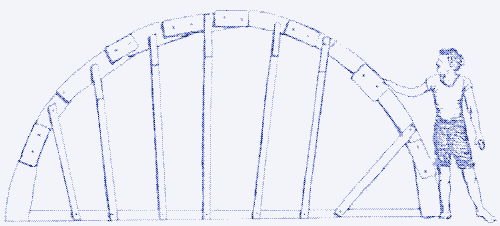
Energy Bulletin pointed us to the website of Practical Action (previously known as the Schumacher Centre for Technology & Development), an online resource devoted to low-technology solutions for developing countries. The site hosts many manuals that can also be of interest for low-tech DIYers in the developed world. They cover energy, agriculture, food processing, construction and manufacturing, just to name some important categories.
I would like to add to this the impressive online library put together by software engineer Alex Weir. The 900 documents listed here (24 gigabytes in total) are not as well organised and presented as those of Practical Action, but there is a wealth of information that is not found anywhere else.
Other interesting online resources that offer manuals and instructions are Appropedia and Howtopedia. These are all wiki’s, so you can cooperate. The Centre for Alternative technologies has many interesting manuals, too, but the majority of those are not for free.
Reactions
To make a comment, please send an e-mail to solar (at) lowtechmagazine (dot) com. Your e-mail address is not used for other purposes, and will be deleted after the comment is published. If you don’t want your real name to be published, sign the e-mail with the name you want to appear.
Reactions
Neil Noble
Practical Action was originally called the Intermediate Technology Development Group (ITDG) and its head office is at the Schumacher Centre for Technology & Development, named after Fritz Schumacher the founder of ITDG and author of Small is Beautiful.
Rasmus
Instructables should also be mentioned.
kdd
http://www.instructables.com/
KDB
Instructables thirded.
In 1999 most people were laughing about the (probably (apparently) unnecessary) disaster preparedness the alleged the Y2K event.
At that time I said “Why is it a bad idea to be ready for when something big goes wrong?” It’s not going to be WW3 (probably) but overall it’s not if but when. Sooner or later things will go wrong. A hurricane, earthquake, whatever 5 days worth of water and three days of food is never a bad idea.
Protip: a hand crank generated shortwave internet capable device is under $200. Food fuel and that and you are ready for almost anything.
Paul Badon
I made a Baking oven / water heater from a steel barrel cut round not length ways, with a hammer, a broken butcher knife ,a nail ,a screw driver ,some sheet metal screws and a couple of sections of 3 inch vent pipe. I cut the barrel apart by hammering the knife into the metal made the door opening and vent opening the same way . Holes for the screws were made with the nail. Set the bottom on the top for the oven.hammered the metal around the bottom flange for holding it into place. I Can post the better instructions on Face Book >Survivor Polk County if any one is interested .
Anonymous
Anyone have a revised link for the Alex Weir library? The combined download link seems to be down
kris de decker
http://www.fastonline.org/CD3WD_40/CD3WD/INDEX.HTM
Damian
Is it still available on the new link? Because I only found four articles which are not in english.
Aïdeis
The link with the book list: http://www.journeytoforever.org/farm_library/cd3wdbooks.html
Eian
All of the FastOnline.org links don’t seem to be working any more. They all go to the main page of a non-english blog(?) it seems. All of the other links are also bad.
Mario
2012 dated iso and torrent available on archive.org
Ben
torrent apparently availaible for Alex Weir materials
https://web.archive.org/web/20111018151527/http://www.cd3wd.com/CD3WD/index2.htm">http://www.cd3wd.com/CD3WD/index2.htm">https://web.archive.org/web/20111018151527/http://www.cd3wd.com/CD3WD/index2.htm